Trying to Time the Market is Like Playing ‘The Traitors’

Until recently I was seemingly one of the few people who hadn’t seen the TV show ‘The Traitors’.  It became popular so quickly that my stubborn, contrarian streak prevented me from indulging. After some persistent persuasion from my children, however, I succumbed and have been watching the latest UK ‘celebrity’ version. Not only do I have to reluctantly admit to enjoying it, but I have found the contestants’ – often baffling – approach to the game starkly reminiscent of some of the most destructive investor behaviours.

For the uninitiated, the game is very simple. A group of (20 or so) people are put together and a small subset (usually 3) of them are secretly selected to be ‘traitors’. Each day the traitors covertly select one of the ‘faithfuls’ to ‘murder’ (remove from the game). Also, each day, the entire group have to discuss and vote to banish a member of the group who they suspect of being a traitor. For the faithfuls the aim is to rid the group of traitors, while for the traitors it is to remain undetected until the end and claim a prize for themselves. (Party game fans may recognise this structure from Mafia / Werewolf).

A distinctive feature of the game is the almost complete absence of useful evidence the players can use to guess who might be a traitor in the group. The traitors are selected by the producers prior to the show, and players must make judgements based on their interactions with each other during the game. 

The way players decide on who to banish for being a suspected traitor follows a consistent blueprint:

– There is virtually no meaningful evidence about who is a traitor.

– All players significantly overstate their skill in ‘reading’ people and hugely overweight meaningless information. 

– Players construct persuasive, compelling and entirely spurious reasons about why another participant is a traitor.

– The players who put together the most elaborate arguments are considered smart even though they are consistently wrong.

– The player identified as a traitor is banished and it transpires that they were a faithful.

– Players lament their approach and consider whether a different strategy might be worth considering next time.

– In the following round they do precisely the same thing, seemingly forgetting it didn’t work before.

These are all very human behaviours and almost identical to those that we see from investors attempting to predict the short-term movements of financial markets.

The hallmarks of which are:

– An environment defined by noise and very few signals.

– Massive levels of individual overconfidence in the skill to make predictions about asset class performance.

– A wonderful ability to create impressive and coherent stories about market conditions.

– Credibility and airtime given to investors who sound smart.  

– Those investors frequently being wrong.

– Everyone carrying on doing the same thing anyway without acknowledging it didn’t work before.


Whether we are trying to guess who the traitor is in a party game or predict the performance of US equities over the next 6 months, the patterns will be familiar. We will inevitably see evidence where there is none, be wildly overoptimistic about our own capabilities, and create stories to alleviate the discomfort of randomness and uncertainty.

Human behaviour doesn’t change much, just the context. 


My first book has been published. The Intelligent Fund Investor explores the beliefs and behaviours that lead investors astray, and shows how we can make better decisions. You can get a copy here (UK) or here (US).

All opinions are my own, not that of my employer or anybody else. I am often wrong, and my future self will disagree with my present self at some point. Not investment advice.
Gold is the Ultimate Belief Asset

Although it could have easily escaped your attention, as it has received such little fanfare, the price of gold has been rising sharply – recently surpassing $4,000 per ounce. Significant moves in the gold price are fascinating from a behavioural perspective because gold is probably the perfect belief asset – that is an asset which is impossible to value in any reasonable way so it’s worth is entirely dependent on what we think other people believe it to be. This has significant implications for how gold might behave, and how people both talk about it and trade it. 

We are currently in the stage of the cycle where many people conjure up reasons for why gold is so attractive because they cannot admit that they mainly like it because its price has gone up a lot. That is not to say that there are not valid reasons why an investor might hold the asset but, as usual, near term performance must bear much of the responsibility.

How should investors think about gold?

Gold is not a better form of money: One of the most common and vociferous arguments from investors who are bullish on the prospects for gold is that it is far superior to standard fiat currencies because it holds its value, whereas the like of the US dollar or sterling lose their purchasing power through time. This view makes very little sense. In a well-functioning and growing economy, a positive level of inflation is desired – it encourages spending and investment – this means currencies should lose value through time. It is a feature not a bug. Yes, a dollar today may buy you less than it did 30 years ago, but I am pretty sure that salaries have changed over that time also, and I am confident people do things with their money – like spend it and invest it.

The merits of owning gold change depend on what question you ask. Is holding gold over the long-term better than putting cash under the mattress? Quite possibly. Is holding gold over the long-term a better option than owning productive, real economic assets (such as company shares)? I am not so sure.

Gold has excellent Lindy properties: Although the ‘debasement’ argument often made about gold is an exceptionally dubious one, gold does benefit from the Lindy effect. This is the idea that the expected life of something that is non-perishable is proportional to its current age. In simple terms this means that the longer something has existed, the longer we assume it will last. (The expected future life of Great Expectations is significantly longer than anything published last week). The concept is named after Lindy’s deli in New York City where it was speculated that a show running for a month on Broadway could be expected to last for another month.

Gold has been used as a store of value for thousands of years. People have believed in it for an extremely long time, which should give us some confidence that people will keep believing in it. This feels somewhat amorphous – but when you don’t have much else to go on it matters.

Belief assets can be extremely volatile: The more assets are based on belief than anything tangible the riskier they are likely to be. Why is this? If an asset is driven by strong fundamental features – let’s say a high-quality bond with a contractual return and fixed maturity – the range of potential outcomes is very narrow. The more speculative the asset, the more it is based on indefinable beliefs, the wider the range of outcomes and the greater the uncertainty.*

Assets that have long-term, fundamental value drivers experience a (sometimes light) gravitational pull towards some form of fair value. As belief assets have no fair value the price can vary widely – this can be both incredibly lucrative and, at times, painful. (Belief assets are perfect for bubble formation – there is nothing to hold them back).

Prices for belief assets change because perceptions change. If the gold price were to drop to $2,000 is it more or less attractive than it is now? Nothing will have changed about the yellow metal, just what people believe other people believe about it.  

Price moves in gold create stories about gold: As we are being bombarded with stories around the reasons for the rise in gold price – debasement, fiscal largesse, central bank purchases, political uncertainty – it pays to remember the causality here. Price moves come first and then the narratives to justify it second. It is not that the stories have no validity, it is just that they become more persuasive the higher the price rises, creating a self-reinforcing loop – for a time at least.   

Do you like the asset or its trend?  Momentum investing has a long and storied history of delivering positive returns – but only if carried out in a deliberate and measured fashion. One of the problems with strongly trending belief assets is that rather than acknowledge that they want to participate in the price momentum, investors need to offer a compelling fundamental rationale. Although this might make them sound smarter, all it means is that they are a closet momentum investor without the discipline required to do it well.

Know why you own it: Perhaps the key for any investor owning gold is to be very clear about why you hold it, otherwise you risk being whipsawed around as price trends (and beliefs) fluctuate. If you purchase it tactically be specific about the precise factors that are informing your view (even if it is just trend following). If it is a structural portfolio holding you should be willing to bear periods of significant losses with equanimity and understand the exact role it is playing.  


There is nothing inherently wrong with holding gold, but it is important to accept the type of asset it is and the investment behaviour it may encourage. If Ben Graham had been asked about gold, he may have said something like:

In the short-run, the market (for gold) is a voting machine, and in the long-run it is also a voting machine.


* Whether an asset is a belief asset or a fundamental asset can also depend on time horizon. An equity investor trading on a three-month view is turning stocks into a belief asset because they are worried only about sentiment (belief) changes – the fundamentals are largely irrelevant.


My first book has been published. The Intelligent Fund Investor explores the beliefs and behaviours that lead investors astray, and shows how we can make better decisions. You can get a copy here (UK) or here (US).

All opinions are my own, not that of my employer or anybody else. I am often wrong, and my future self will disagree with my present self at some point. Not investment advice.

Invest Like You Are Bad at Making Predictions

Investing can often feel like one giant prediction game. Most financial market commentary involves forecasts about the future that are hastily discarded and wilfully forgotten, and many investment approaches are founded on taking bets about the complex interactions of economies and asset prices. The problem with all this activity is that the world is a highly uncertain place and we are wildly overconfident in our ability to foresee what will happen next. A fact confirmed (again) in a recent study by Jeffrey A. Friedman, an associate Professor of Government at Dartmouth College.

Friedman ran a large-scale study of over 63,000 judgements made by nearly 2,000 national security officials from NATO allies and partners. The expert participants were given a set of 30 to 40 statements and had to estimate the chances that they were true.

Such as:

“In your opinion, what are the chances that NATO’s members spend more money on defense than the rest of the world combined?”

Or apply probabilities to future events: 

“In your opinion, what are the chances that Russia and Ukraine will officially declare a ceasefire by the end of 2022?”


How did these experts fare when posed these questions?

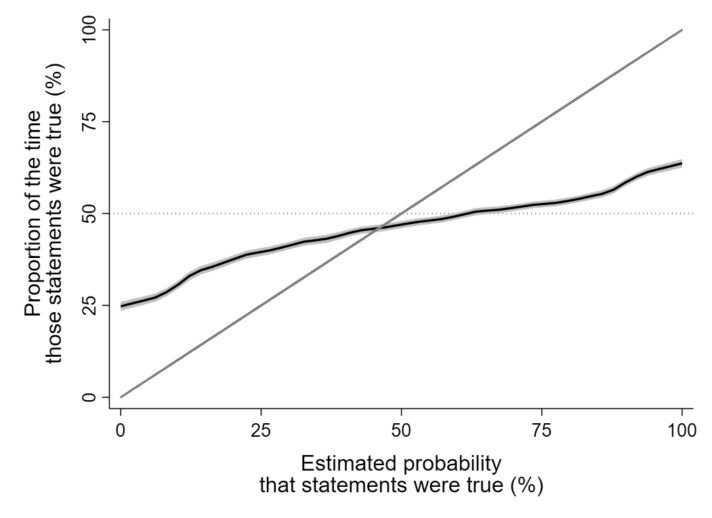
It is fair to say that their calibration was a little off or, to put it another way, they exhibited pronounced levels of overconfidence.

When the officials believed that a statement was likely to be 90% true, this was the case on only 57% of occasions.  On the flip side, when a statement was assigned a 10% likelihood of truthfulness, it was correct 32% of the time. Notably, participants were more likely to say something was true when it was not, than the reverse (false positives were more common).

There was also a problem in dealing with certainty. When a participant had absolute confidence that a statement was false, they were incorrect 25% of the time. (They were obviously ignorant of Cromwell’s rule).

Here is a visual depiction of the calibration gap, or level of overconfidence:  


Friedman’s paper goes in to more detail on the study, and he has also written an excellent book on decision making under uncertainty, which I would strongly recommend, but I wanted to turn to the implications of this study for investors:

– Be very careful with geopolitical risks: Investors get very excited about geopolitical risk and love the opportunity to become foreign policy experts for the week, but making decisions based on geopolitics should be avoided. In Friedman’s study, experts in the field consistently made off the mark, poorly calibrated judgements – what chance do generalist investors have?

– Financial markets are harder to predict than most things:  Although the foreign policy questions in Friedman’s study were difficult, they are not as challenging as those many investors try to tackle. When investors make market predictions they are attempting to forecast something as complex and chaotic as the global economy and how that will impact financial markets. It is incredible to me that anyone thinks this is possible.

– Reduce your confidence levels: The participants in the study were overconfident, investors are overconfident, humans are overconfident. A very useful rule of thumb is to reduce our conviction every single time we express a view, this will almost certainly make our guesses more realistic.

– Don’t make an investment approach reliant on predictions: I appreciate that it feels like we should be constantly making predictions about financial markets – it is interesting, lucrative and everyone else is doing it – but it is a really bad idea. 

– Make easier predictions:  Of course, all investing involves making predictions about the future in some form but let’s make easy ones. I predict that over the next decade economies will grow, and stock markets will generate real returns. It is a forecast, and it is not certain to be true, but I have a reasonable level of confidence in it being so. Simple predictions, humbly made are always the way to go. 

Reduce overconfidence by diversifying: Diversification is an exercise in humility. The future is uncertain, and we are terrible at making predictions, so our portfolios should reflect this.


If you are reading this and thinking that financial market forecasts are not really as difficult as I am making out then feel free to replicate Friedman’s test. Make a set of statements about the future and apply a probability to them being true. Things like these:

The ten-year US treasury yield will be above 5% by the end of 2026.

 or

The US equity market will not lose more than 25% in value at any point over the next 12 months.

Let me know how you get on.


It is an oddity that investors are often reluctant to systematically measure themselves in this way given how much time we spend making predictions. It suggests that even though we behave in an overconfident way underneath it all we know the truth, we would just rather not remind ourselves of it. 


My first book has been published. The Intelligent Fund Investor explores the beliefs and behaviours that lead investors astray, and shows how we can make better decisions. You can get a copy here (UK) or here (US).

All opinions are my own, not that of my employer or anybody else. I am often wrong, and my future self will disagree with my present self at some point.