Few Things Destroy Long-Term Investment Returns Like Short-Term Measurement

I am apprehensive about writing a post that is critical of performance benchmarks for active management as accountability is of paramount importance and comparing returns to a relevant benchmark is a valuable means of assessment. With those caveats in place, I now wish to argue that our use of benchmarks – specifically for short-term* performance measurement – is a major behavioural problem and one that transforms the job of active management from difficult to close to impossible.

The simple, but critical, point is that the way in which we measure something can have a profound impact on our behaviour, and be of detriment to our ultimate objective even if the measure is optically sensible.  Many of us will have heard stories confirming this idea – in the United Kingdom the imposition of hospital waiting time targets by the National Health Service (NHS) has consistently backfired, with behaviours often directed toward hitting the specific target, at the expense of all else (a case of Goodhart’s law in action**).  This issue is discussed in a paper by Bevan and Hood (2006), which compares the NHS situation to measures of productive output in the Soviet Union, which were also blighted by ill-judged performance targets and unintended behavioural consequences.

For active management the situation involves taking a reasonably effective (albeit imperfect) measure of success (long-term performance versus a benchmark) and then employing that same measure over a much shorter-time horizon, a period for which it is often devoid of meaning.  The view seems to be that if it is a valid measure over the long-term then it can also be assessed over far more limited periods.  If we can measure it over five years, why not three months, one month, one day?  A significant amount of time is wasted and behavioural damage wrought by constantly appraising noisy short-term performance data.

If there is any skill in active management, then it can only be identified over the long-term; short-term performance numbers are a sea of randomness searching for a narrative.  To validate this point, let’s take Michael Mauboussin’s simple heuristic for judging whether an activity is more driven by luck or skill – can you fail deliberately?  For active investment management, over the short-term, the answer is absolutely not; it would be impossible to confidently select a portfolio of securities that would underperform over a day or even three months (it is entirely random), however, over the long-term it might just be possible.  Certainly as the time horizon extends someone with skill in the field should have greater confidence in meeting this threshold.

Of course, the challenge for active management is that short-term performance data is available, so therefore we feel compelled to measure it, analyse it and assess it. I find it constantly baffling that anyone believes there is much information of substance such performance numbers, the only obvious exception being where relative performance diverges from what one might reasonably expect given the approach adopted by the fund manager. To believe that short-term returns tell you anything about the skill of an active manager, is to believe that certain individuals have the ability to predict short-term market movements.  They don’t.

The problem with short-term performance analysis is not simply that it is a weak measure and rarely constitutes meaningful evidence, but that it has come to dominate investment thinking and decision making.  Unfortunately, long-term outcomes are reached by experiencing and reacting to many periods of short-term performance.

How do active fund managers react to endemic short-termism? By reducing the risk they assume relative to their benchmark comparator. There is little point being a long-term investor, if you are fired after a year for ‘consistent underperformance’. There is great confusion at the heart of the debate around active management – on the one hand there is a drive for high active share managers who can justify their existence, but also a complete intolerance for spells of underperformance. These views are entirely incoherent.

Active management groups are interested in maintaining and growing assets. The dominance of closet trackers / index-hugging strategies is in part a consequence of the focus on short-term performance measures. Tracking errors are managed and ‘active risks’ are scrutinised as genuine active management is sacrificed and long-term decision making stymied to avoid descending to the foot of performance tables.

What are the consequences of professional fund investors’ use of short-term performance measurement? A great deal of entirely unnecessary activity.  There is so much data available that it is irresistible; it is possible to construct all sorts of compelling narratives backed by supporting evidence and statistics. As fund investors we have every opportunity to scour daily / monthly / quarterly performance and make grand conclusions based on noisy and unreliable attribution. This brings us to a perennial problem of the investment industry – it is hard to prove your worth by doing less (even if it is the best course of action), being busy is often career-enhancing.  It is easy to produce analysis that weighs a lot and means a little.

In defence of active fund investors, even if they wanted to focus on quality of process and genuinely long-term performance, they are often serving others for whom short-term performance is paramount. Why pick a high active share manager if you are likely to be hauled over the coals every other quarter to explain underperformance? Furthermore, remuneration will often be tied to the performance of funds recommended over time horizons where the outcomes can be considered no better than random.  Most professional investors in active funds are incentivised (in the broadest sense of the word), to not take too much benchmark risk, be similar to everyone else and recommend funds with a strong recent track record that might still have some momentum.

Although I am often an advocate of doing nothing as a superior investment strategy, my criticism of the use of short-term performance measures is not about adopting a hands-off approach to active manager research, rather ensuring that the focus is on the right things.  It is possible to have a granular understanding of an active manager without being consistently diverted by short-term vacillations in relative performance. Process must always trump outcomes; time should be spent understanding fund manager behaviour and whether it is consistent with expectations, not whether they have beaten a benchmark over some arbitrary period.

The basic message here is this – if you are worried about short-term relative performance, avoid active managers, if not you will spend a great deal of time making consistently poor investment decisions. For those committed to active management, it is imperative to put steps in place that support and foster it.  This will often involve taking decisions that seem entirely counter-intuitive given how the investment industry has evolved in recent years.  If you are employing or analysing short-term performance measures, you are inevitably shaping behaviour and reducing the chances of long-term success.

—-

* It is difficult to precisely define what is meant by long and short term and it depends on what you are talking about.  For active management I would argue anything under one year is short-term and anything over five years is long-term.  The bit in the middle we can debate.

** In simple terms, Goodhart’s law states that when a measure becomes a target it ceases to be a useful measure.

Key Reading:

Bevan, G., & Hood, C. (2006). What’s measured is what matters: targets and gaming in the English public health care system. Public administration, 84(3), 517-538.
Are Index Fund Investors More Vulnerable to Bubbles?

One of the most superficially persuasive criticisms of passive equity index investment regards its susceptibility to bubbles and fads.  Indeed, this ‘vulnerability’ is an inescapable feature of market cap based index investing –  if a certain subset of the equity market becomes wholly detached from its fundamental attributes and extremely overvalued, an investor in a market cap tracker of that index will see their existing exposure increase and additional cash flows allocated in a greater proportion to this area.  The dot-com bubble is often cited as an example of a period when a simple passive market cap index investment was a decidedly poor choice.

Implicit in this criticism is the view that active management is better suited to this type of environment and avoids many of the aforementioned issues that would beset market cap equity index funds.  The problem with this line of thinking is that it only looks at one-half of the equation – focusing on what happens to index funds, rather than the probable behaviour of many actively managed strategies.

Let’s assume that a bubble emerges in a particular segment of the equity market and persists for a number of years before the ‘inevitable’ denouement.  We are aware of the implications for market cap passive investments – but what can we assume about the active management industry against such a backdrop?

– Active funds participating in the bubble areas gain flows and popularity due to strong performance.

– Many active managers abandon their philosophy and process to keep pace with market.

– Active managers avoiding the bubble assets lose assets / their jobs.

– Index aware / closet tracker funds increase exposure to bubble assets to manage tracking error.

– Fund selectors bemoan the relative underperformance of dogmatic managers for failing to adapt to the ‘new paradigm’.

– Money flows from active manager laggards to active manager outperformers. Fund investors crystallise recent underperformance and lay the foundations for future underperformance.

– Quantitative performance screens of actively managed funds uniformly highlight funds that have participated in the bubble as the most ‘skilful’ and ‘consistent’.

– Quantitative risk systems will show that active funds are running too much tracking risk by avoiding the bubble stocks.

– A minority of active managers will withstand the underperformance and remain faithful to their investment approach, but not without haemorrhaging assets.  This select group will be lionised as the bastions of active management after the reckoning.

Bubbles are formed by a compelling narrative, which is validated and emboldened by abnormally strong returns.  The notion that there is some great divide between the susceptibility of active and passive investors to such a scenario is spurious – even only on the basis that the active management industry makes for a reasonable sample of the market and therefore in aggregate will suffer in a similar fashion.

The idea that active managers will be standing steadfast against an irrational and unsustainable bubble that occurs in an area of the equity market – whist passive index investors blindly chase returns – runs contrary to the nature of bubbles, and the incentives and behaviours that have come to define much of the active management industry.  Furthermore, all of the evidence points towards fund investors heavily favouring recent outperformers – which will be those active funds that have embraced the new fashion.

Investment bubbles are alluring and persuasive, and it is only hindsight bias that comforts us that they are easy to identify and avoid.  As active management seemingly becomes increasingly myopic and focused on performance chasing / asset gathering, the ability to avoid bubbles reduces – if such a situation persists for any length of time most simply have to participate.

Of course there are exceptions to this – that select group of active managers that have a clear philosophy, operate in a supportive environment and hold a willingness to diverge markedly from the index.  These are the type of managers that fund investors should always seek out, but they are also the hardest to own, particularly in the midst of a fervent and sustained bubble, through which they will come to appear outmoded and unskilled.

In theory, any material and sustained detachment of an asset’s price from its fundamentals should prove a boon for active managers; however, this makes assumptions about time horizons and incentives that are at odds with the behavioural reality. There is no compelling reason to believe that passive market cap equity investors are more vulnerable to bubbles than their active counterparts.

The (Other) Problem with Active Management

Active management is difficult.  Only a minority of managers outperform after fees over the long-term and it is difficult to identify those which will ex-ante. Whilst this dominant critique undoubtedly has validity, there is another major hurdle for active management, which relates to the perceptions and behaviour of fund investors.  It means that even if we can successfully isolate managers with skill, there are no guarantees that we will reap the benefits of it.

There is a paradox at the heart of active management; to justify its existence the focus should be on differentiated and high conviction approaches; however, the more genuinely active a strategy is the greater the likelihood that it will experience spells of pronounced and often prolonged underperformance, which will be unpalatable for many investors.  There is a justified clamour for high active share managers; but little consideration as to whether we are behaviourally disposed to owning such investments.

Let’s take an example; in a twenty-year period ending in 2007 a prominent active equity fund delivered an annualised return of 15.0% compared to 10.9% for its benchmark comparator. This meant the closing value of an initial investment in the active fund was over double that of a passive holding in the index.  This is clearly a compelling outcome (net of fees), however, it is also important to look at the return profile through a different lens; somewhat unfortunately, even as long-term investors we have to ‘experience’ the vicissitudes of shorter-term performance:

– Across rolling one year periods (shifting one month forward) the fund underperformed its benchmark on 34% of occasions.

– On 17% of the rolling one year periods excess returns were more than 10% behind the index.

– For 29% of rolling three year periods the fund trailed the index.

– On 16% of rolling three year periods the fund trailed the benchmark by more than 20%.

Highlighting these features is not designed to be a slight on the strategy; rather it is a reflection that even successful active funds will suffer protracted periods of challenge.  Indeed, if a fund is truly active and idiosyncratic then such spells of poor performance are inevitable and have to be withstood to garner the longer-term benefits.

Historic performance numbers seem anodyne written on the page and we often focus purely on the ultimate outcome delivered rather than importance of the path; yet it is crucial to consider what is likely to occur during those days, months and years of owning an underperforming strategy, and how it might influence our behaviour and decision making:

– Outcome bias will lead us to doubt the quality of the manager and find problems even if they possess significant skill, and nothing has materially altered in their approach.

– Myopic loss aversion will mean that short-term (relative) losses will weigh heavily, even if we are investing with a long horizon.

– A disproportionate amount of time and focus will be spent on the strategy through exacting periods – the emotional and cognitive load will be high.

– If the fund manager has a high profile they will be subject to significant industry media scrutiny, poring over individual decisions and highlighting every stock disappointment. Persuasive narratives will be formed about decline of the manager or style adopted.

–  For professional fund investors there will be constant scrutiny from colleagues, risk teams and clients.  Continual justification for the decision will have to be provided.

– The fund may suffer from outflows – do we want to be the last person remaining in the fund?

– Other flavour of the month funds / strategies will attract attention (many of which will be generating outperformance through sheer chance or some favourable style bias).

Then there is, of course, the additional problem that it might not be an ’admissible’ period of underperformance – something about the philosophy, team or process may have changed to its detriment, or our initial analysis about the skill possessed by the manager may have been incorrect. Thus, whilst we may retain belief in a struggling manager, we could be wrong and facing the worst possible situation – consistently expressing commitment to our initial view before finally capitulating and acknowledging a mistake (or concocting a rationale as to why now is the right time to sell).

It is far easier to buy outperforming funds and sell the stragglers – it is simple, appears ‘sensible’ and is behaviourally comfortable – this type of performance chasing is covered in a 2008 paper by Goyal and Wahal.  Conversely, it requires a great deal of fortitude to persist with a manager that is materially underperforming – even when we know that the shorter-term outcomes are not inconsistent with reasonable expectations given the approach adopted. The psychological and potential career pressures / costs of owning a high conviction manager and persisting with them through underperformance are stark.

If we are lucky, we will buy into a differentiated manager with skill who has historically outperformed (because, let’s be honest, nobody buys underperforming funds) and the pattern of excess returns persists with few meaningful blips. This, however, should be treated as an anomaly.  When owning a genuinely active fund we are likely to experience numerous and sometimes severe bouts of underperformance; unless, that is, we have managed to identify a style that is always in favour or a soothsayer who can foretell short-term market movements (I am still searching).

Much attention is lavished on the difficulties of identifying a skilful active manager with the potential to deliver excess returns, but that is only the beginning. As markets don’t provide consistent short-term rewards for the talented – you need to be able to hold for the long-term whilst bearing the inevitable periods of poor performance and all that entails. If you cannot, then you should avoid active management.

Key reading:

Goyal, A., & Wahal, S. (2008). The selection and termination of investment management firms by plan sponsors. The Journal of Finance63(4), 1805-1847.

The Death of Diversification

It has been a propitious period for equity investors; over the previous five years they have enjoyed stellar returns, depressed volatility and relatively few instances of material drawdown. The prolonged nature of this environment risks the abnormal coming to be seen as normal, and our bias towards what is recent and available leading to expectations becoming untethered from reality. This could have profound implications for how we perceive (or ignore) risk and how portfolios are constructed.

The success of equities on a risk-adjusted basis in recent years can be framed in a different fashion – the failure of diversification. Against a backdrop where equities have delivered strong performance with reduced risk (compared to history) there has been scant reward for holding assets that are regarded as diversifying or that may offer insulation in a more inclement economic landscape. Indeed, diversification has come at a cost.

There is a real danger that the current environment is leading investors to worry about the wrong things. Rather than believing that prudent diversification is evermore important because of the unusually strong results delivered by equity markets; we do the opposite and start to question the role in our portfolios of those assets that have failed to keep pace with the ascent of equities. In recent years very few assets compare favourably to equities – so why hold anything else? We spend far too little time critically assessing the things in our portfolios that are out/over performing.

Arguments in support of diversification are made all the more difficult by the fact that equities have exhibited such low ‘risk’ in recent years (by way of realised volatility and drawdowns), a scenario that inescapably breeds complacency. There are technical and psychological aspects to this problem. From a technical standpoint, it is possible to build equity heavy portfolios with low ex-ante risk (in terms of volatility) if their look-back period is only three or five years. From a psychological perspective, memories of the stress and fear that can at times characterise the ownership of equities have been all but extinguished. We can easily recall equities makeing consistent upwards progression, not them halving in value.

The unusually strong risk-adjusted performance of equities has also created a process versus outcome problem, where simply being long equity risk has been consistently rewarded, irrespective of whether it was a prudent course of action ex-ante. Our pronounced tendency to judge the quality of a decision or process simply by its outcome means that we will look more favourably on less diversified, equity-centric portfolios. The corollary of this is that the pressure of unfavourable performance comparisons could lead to diversified portfolios being ‘forced’ to assume more equity risk.

The idea of diversification is to create a portfolio that is designed to meet the requirements of an investor through a range of potential outcomes – it should be as forecast-free as possible. It is also founded on the concept of owning assets that not only provide diversification in a quantitative sense (through low historic correlations) but also sound economic reasons as to why their return stream is likely to differ from other candidate asset classes. Crucially, in a genuinely diversified portfolio not all of the assets or holdings will be delivering strong results at any given time, indeed, if all of the positions in a portfolio are ‘working’ in unison – it will feel like a success but actually represent a shortcoming.

That is not to suggest that we should persist with assets or positions in a portfolio simply because they are diversifying (or have not gone up as much as equities). Rather that we should always remember the long-term benefits of diversification, and consider the merits of all holdings in a portfolio based on their own characteristics and their role amongst a mix of assets or strategies.

Our obsession with outcomes, focus on spurious reference points and our desire for action, makes remaining diversified incredibly challenging. In an equity bull market, we often struggle to see the laggard assets in our portfolio as distinctive and differentiated – serving the role they were required for – we instead identify weakness and something that needs to be addressed. This is exacerbated by the fact that in such periods the returns of everything gets compared to equities – whether the comparisons are valid or not is irrelevant.

At this point in the cycle the temptation to abandon the concept of prudent portfolio diversification is likely to prove particularly strong; but unless a new paradigm is upon us, investors will be well-served remaining faithful to sound and proven investment principles.  Take the long-term view and remain diversified.

Things to Remember When Selecting an Active Fund Manager

These are simply some musings on active manager research; seemingly random, but hopefully linked by a common thread:

– The more PhDs in a team, the greater likelihood that a fund will blow up. This is tongue-in-cheek comment, but underlying it there is an important point about complexity. It is perfectly acceptable not to invest in a strategy because you don’t understand it. Furthermore, academic pedigree can easily make investors unnecessarily complacent about the robustness of a fund.

– Fund groups will always find some room in their strategy for you, capacity limits are more flexible than you think.  Incentives matter – you should never be reliant on an asset manager to tell you when they have reached capacity in a fund (particularly if they are listed) and, if you are waiting for them to tell you, it is probably too late.

– Although the majority of active managers underperform the market, the majority of slide decks produced by active managers will show them outperforming. The slicing and dicing of performance numbers is a constant wonder.

– Just because a Brinson attribution report shows a positive ‘selection effect’, it doesn’t mean there is ‘alpha’ – it is probably just a style bias. The term ‘alpha’ is banded around with abandon when discussing fund manager performance often without any clarity about what that actually means. Perhaps the most common is stock / sector decomposition – which tells you nothing about style / factor skews.

– The majority of excess return in fixed income strategies comes from assuming additional credit risk. Another attribution problem – this time for credit – is the persistent overweighting of credit risk (relative to the benchmark). Attribution for credit managers is fiendishly difficult but is an investment grade manager permanently overweight high yield skilful?

– Unless you believe that many fund managers can time the market (they can’t), then performance consistency is an example of luck or the derivative of a persistent style bias. It is rarely skill.  I still don’t understand the obsession with short-term performance consistency in the industry – the focus on this does much more harm than good in promoting the right type of active management.

– You will never really know the inner workings of the team running the fund you are researching. No matter the quality of your due diligence, your understanding of the characters, relationships and motivations within an external team will always be partial.

– Diversity for many (UK) asset managers means hiring white men from both Oxford and Cambridge. There is too much virtue signalling and not enough action on diversity in the industry.

– Ego / arrogance is not a necessary or positive trait for a fund manager. I often hear people absolve certain fund managers for being ferociously arrogant on the basis that they need to have high levels of confidence to ‘bet against the market’. This is nonsense – good fund managers will be wrong (a lot) and need both humility and a willingness to learn; believing that their views are unimpeachable or that they are infallible is the obverse of this.

– At least 90% of equity managers say they are buying quality companies (barriers to entry etc…) that are undervalued.  This should tell you something.

Is Volatility Risk?

I disagree with the majority of people I respect in the investment industry about volatility. This is an uncomfortable situation, as holding a view contrary to people more intelligent than yourself is rarely a sensible course of action.  Nevertheless, I shall persevere.

Most of the aforementioned investors have claimed at some point that “volatility is not risk”.  This is, of course, correct; risk is a multi-faceted concept, which no single metric can successfully capture, however, the implicit (sometimes explicit) extension of this argument is that volatility is not a valid measure of risk at all.  I do not believe this to be true.

The renunciation of volatility is often followed by the comment that “permanent capital impairment” is the only genuine risk. This view assumes that risk is based on the probability of the fundamental value of an investment being than less you paid for it.  The problem with this pure perspective is that it assumes that permanent capital impairment is solely about the asset and not the investor, and that the variability of an asset’s price through time is irrelevant.

From a behavioural perspective, volatility and permanent capital impairment are inextricably linked. I would assume that the most common cause of the latter is not a fundamental change in an asset’s intrinsic value but a decision by the investor to sell at an inopportune time.  The path of returns for any given asset is crucial; volatility is not simply about the variability of an asset’s price, but how those fluctuations impact investor behaviour and the resultant cost.

As volatility is a somewhat nebulous concept, it is worth considering what drives fluctuations in asset prices.  I tend to think of three related aspects:

1) A change in the fundamental value of an asset.

2) Uncertainty over the fundamental value of an asset and our behavioural reaction to uncertainty.

3) Investors reacting to the behaviour of other investors (momentum) or anticipating how they think other investors will behave. Markets are reflexive.

Investors do not experience volatility in isolation, it is not simply about detached price movements – there are inevitably accompanying narratives that lure us into action.  Volatility is circular; it is created by our behaviour – our emotion laden decision making, our myopia, our loss aversion, our recency bias – and in turn it drives our behaviour. It is often absurd and frustrating, frequently bearing no relation to sound fundamental investment thinking, however, it is a reality and it matters.

In addition to the behavioural nature of volatility, it is also heavily reliant on technical factors such as how an asset is priced and how it is traded. To take an example of this, let’s assume that an S&P 500 index tracker only provided liquidity windows every five years and the underlying components were revalued quarterly based on some form of DCF methodology.  Given that the holdings are identical would the risk differ from the market priced, daily liquid version we have available today? It is almost certain that the volatility would be considerably lower*.

Someone from the ‘permanent capital impairment’ camp would likely argue that this proves the flaw in using volatility as risk – the same assets can exhibit different levels of risk if judged by their volatility just by altering how they are traded and valued. However, the notion that volatility should be ignored because it is about more than simply the fundamental features of an asset seems spurious – a sensible theoretical concept that does not match reality. Investors have to experience price variability when holding investments and that has material implications for their behaviour and decision making.

Volatility is an imperfect measure of risk, particularly in regard to the distribution of asset class returns (non-normality) and assumptions around correlation. It is also backward looking and insensitive to valuation. It is certainly limited in the following circumstances:

– Investments with significant tail risk (such as selling insurance). Volatility is a poor gauge to the potential risk in such situations.

– Undiversified portfolios with high idiosyncratic risk.

– Assets with stale / slow pricing such as direct property and private equity.  Assets which are illiquid or aren’t daily traded often benefit from compelling Sharpe Ratios, simply because volatility is subdued relative to more frequently priced counterparts. This is never a fair comparison.  There is certainly a behavioural return premium attached to illiquid assets because it is harder to make stupid decisions when you are unable to trade.

We should be measured when conflating investment risk with any specific metric, it is heavily dependent on the individual, the environment, the instrument and the asset(s). Each method we employ will have limitations, take the following two examples:

1) Assume that the long-term volatility of global equities is 17% and you make an investment when realised volatility has been 17% over the previous three years.  In the subsequent three year period, global equities rise by 50% (primarily through valuation change) with a realised volatility of 14%.  Given that the historic volatility (three year) is  lower than when you made your investment, is the risk, other things being equal, now reduced? Given valuations are significantly higher it would be difficult to make this case, although using a simple (short-term) standalone volatility look-back would suggest so.

2) The probability of realising a loss over a 30 year holding period for global equities is low; from a permanent capital impairment perspective, does that mean that for those with a 30 year holding period holding equity exposure is close to riskless? ** To believe so suggests that the path, distribution and sequence of returns are irrelevant, as is how an investor may react to these factors.

Investment risk is nebulous and difficult to define – there is no unimpeachable means of gauging it. Volatility certainly has limitations and it is not ‘risk’, but can be an important measure of it.  One should never view risk purely through the lens of volatility, but ignoring it is equally naive – permanent capital impairment is as much a behavioural phenomenon driven by the individual human reaction to price fluctuations as it is about the fundamental value of any asset.

*We now have greater liquidity risk.

** Of course a 30 year time horizon is only such for one year, then it becomes a 29 year horizon.

Please note all views expressed in this article are my own and are not necessarily shared by my employer.

Why Do Investors Focus on the Wrong Things?

“Nothing in life is as important as you think it is while you are thinking about it.” Daniel Kahneman

Which major investment issue were you thinking about on March 11th 2016?* You probably can’t remember even though, at the time, it seemed incredibly important.  Whilst most of us should be investing for the long-term, markets conspire against us; lurching from one obsession to the next, drawing our gaze and enticing us to take action.

As the news about a particular event or development takes centre stage, and experts hold forth about the potential outcomes, the notion of doing nothing can seem ridiculous.  The issues are, by definition, salient, recent and available; all factors which make it very difficult for us to have any reasonable perspective on their long-term significance.

It is not that matters such as war on the Korean Peninsula / peace on the Korean Peninsula or Italy leaving the EU are not meaningful (to take recent fascinations), but, from an investment perspective, there is very little most investors can do to benefit.  Each year there is a succession of topics that we become excessively diverted by, where the temptation to act is strong; but before we do, we should try to answer the following three questions:

1) Does it matter to returns?  Given that we tend to hugely overstate the importance of the issue that we are currently focused on, we are likely to assume far more things matter to long-term returns than actually do. It is vital to remember that the historic long-term returns of major asset classes inevitably include periods of tumult at least as significant as the one that currently has our rapt attention.

2) What is going to happen? Even if we are confident in the view that returns will be impacted by a given issue, we then have to predict what the outcome will be.  I think enough has already been said about our ability to forecast such things.

3) How will it impact markets? In the unlikely event that we have identified an event that will materially alter asset class returns and successfully envisaged the outcome, we then need to understand how markets will react.  Markets are reflexive and unpredictable. Do we really know how other investors will behave or what’s in the price?

In simple terms, such activity is incredibly difficult to get right, particularly on a consistent basis.  Even if we have the foresight to identify which events truly matter amidst the clamour – we then need to forecast a particular outcome and the response of markets.  Whilst some professional investors specialise in this activity, most of us should avoid such heroics.

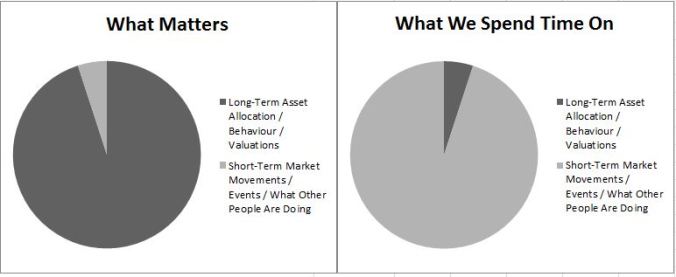
This is easier said than done.  Financial markets create a cacophony of noise and a flow of narratives that we find irresistible; a vicious circle forms where even if we want to disregard an issue, we cannot because it is considered unacceptable to do so.  How can you be ignoring something that is so prominent and material?  Action and opinion are incredibly highly valued, even if their true worth is often negative.  Thus, we end up in a situation where investors spend the vast majority of their time on things that don’t matter and not enough on the things that do.  I imagine the breakdown of investor attention as being something akin to this (entirely unscientific):  

Capture

Having an asset allocation that is suitable for your requirements, considering valuations and thinking about how best to control your behaviour is the surest way to deliver solid results, whilst avoiding the most common investment mistakes.  Taking a long-term approach doesn’t mean you should set once and forget, rather think carefully about your time horizon when making decisions and don’t check your portfolio too regularly.  Doing nothing should be a strong default.

Investing for the long-term seems easy until you understand that it is comprised of many days and many more temptations.  Financial markets will do their utmost to lure you toward the rocks, be sure to tie yourself to the mast.

* This is a random date, I have no idea what particular issues I was being distracted by at the time.    

Noise Destroys Investments Returns as Much as Any Behavioural Bias

As noted by Jason Collins in his excellent behavioural economics blog, Daniel Kahneman’s next book is expected to focus on the concept of ‘noise’ and how it impacts our judgements.  Although often conflated with behavioural biases, noise is a distinct phenomenon that relates to the random variability in our decision making.  Whilst biases exhibit a consistency of effect (at least in direction, if not magnitude), noise is defined by the absence of consistency.  A watch that loses time each day is biased; a watch that can either gain or lose time during any given day is noisy.

In an article in Harvard Business Review, Kahneman, alongside his collaborators, discussed how individual choice is “strongly influenced by irrelevant factors” and gave examples of how professionals are prone to contradict their own previous conclusions.  The problem of attempting to grasp the idea of noise is that it is so amorphous – whilst we can at least develop a (limited) framework for defining and understanding biases, by definition noise is hard to isolate and anticipate. Noise can stem from entirely spurious factors – such as mood, weather or hunger – or variables that we perceive to be meaningful, but are in fact meaningless.  It is certainly possible to test whether noise exists in any given scenario – by observing decision making consistency – but this is only the start of understanding the issue.

Noise has profound implications for investors, but is often ignored or, at least underappreciated. It can be difficult to accept that our judgements can be shaped by erroneous, often farcically minor, factors.  Furthermore, we are often uncertain about the key variables that define any given problem.

In the realm of investment decision making, we can define two separate forms of noise:

  • When given the same objective data and relevant variables we are unlikely to make the same decision. This is consistent with Kahneman et al.’s article – even if we hold the meaningful factors constant, other irrelevant issues will lead to inconsistent choices.

  • We don’t know what the relevant information is and therefore make decisions based on what we perceive to be ‘signal’ but is in fact noise. This is such a major problem – one which the industry perpetuates – that it is difficult to know where to begin.

We could crudely define these as unconscious noise and conscious noise.  In the first case there are many factors that impact our decision making over which we have no real awareness and we would be reticent to acknowledge had any influence over us.  In the second case, the issue is uncertainty about what constitutes relevant information and what is superfluous noise – this will vary by context and discipline, but it is difficult to think of an industry with a greater ratio of noise to signal than asset management. Conscious noise is the oxygen on which the industry, in its current form, exists.

Second by second coverage of random market movements (with accompanying narratives), heroic forecasts (usually wrong), luck masquerading as skill, complex products and every decreasing time horizons are just a few of the factors that contribute to the maelstrom of noise that investors are forced to navigate.  Of course, this is good for the industry – simplicity and inaction are not typically an aid for revenue generation – but it fosters a situation where decision consistency becomes close to impossible for most investors.

Kahneman et al. proceed to argue that a “radical solution” for the problem of noise is the replacement of human judgement with algorithms, or a structured set of decision rules. They also acknowledge, however, that such processes are less effective in environments where uncertainty is high or where consistency is difficult to attain.

Can algorithms be effective  in muting the incessant noise in investment markets, and even exploit it, to improve decision making?  To a certain degree.  One effective and humble decision rule / heuristic, is portfolio rebalancing.  A structured and consistent approach to rebalancing a portfolio back to target weights is proven to be effective and cancels out a great deal of market noise.  It ensures both that your portfolio doesn’t stray too markedly from its desired allocation, and that you consistently sell assets that have become more expensive and reinvest in those that have become cheaper.  Whilst this might seem a simple course of action, rebalancing into assets that have struggled (amidst the prevailing negative market narrative that will inevitably accompany the poor performance) can be difficult without a formal / systematic decision rule.

The oft-mooted remedy to the problem of noise and inconsistency in human-led investment decisions is the movement to full automation and the use of complex algorithms / machine learning.  It deals, at least in part, with the aforementioned ‘unconscious noise’ angle as the feelings of the decision maker are no longer a direct issue, however, at some point human judgement will inevitably exert an influence – for example, in the decision to initially invest in a strategy or to redeem, thus it does not provide full immunity.

More importantly, algorithms do not necessarily resolve the issue over noise in regard to the use of irrelevant information.  Many an ETF has been created based on factors with no empirical credibility; therefore although the decisions within the process can be dispassionate, the very existence of such strategies is reliant on the fact that there is noise in the market.  Furthermore, even the most sophisticated systematic approaches are vulnerable to trading based on patterns than are simply a consequence of random market movements, with no structural, technical, economic or behavioural reason to exist or persist.

Even without full automation, there are means of dulling the noise in human-led investment decision making, such as checklists.  Whilst checklists are particularly effective in areas such as aviation and surgery where many of the checks can be simple and objective –  whether the correct leg is being operated on, for example – they can still improve discipline and focus around decisions with inherently more subjectivity. Formally reviewing a list of your key criteria prior to making an investment can serve to highlight noise driven deviations from your core process and also acts as a useful record for reviewing historic decisions.  Of course, using checklists when answers are subjective means the potential for manipulation is ripe, so it pays to be as rigid as possible when defining questions; however, even if this is not possible, checklists remain a useful means of reaffirming your investment principles amidst the market noise.

Noise is an inescapable feature of human judgement.  In random and uncertain investment markets its influence is profound. Although it is impossible to eradicate, acknowledging its presence and taking steps to simplify and systematise certain decisions can be an effective way of turning down the volume.

Key Reading:

Kahneman, D., Rosenfield, A. M., Gandhi, L., & Blaser, T. (2016). Noise: How to overcome the high, hidden cost of inconsistent decision making. Harvard Business Review94(10), 38-46.

Please note all views expressed in this article are my own and are not necessarily shared by my employer.

Why Can’t Fund Managers Admit Mistakes?

“It infuriates me to be wrong, when I know I am right.” (Moliere)

In a previous job, I worked for an investment consultant who employed a psychologist to assist in their fund manager research process.  I vividly recall her making a particularly astute point about how we constantly hear about the failings of active fund managers, but rarely anything about how they can improve.  Whilst inevitably there are exceptions to this view, it is certainly reasonable to suggest that evidence of fund manager learning and development is scant.  I do not mean that there is a lack of generic, box ticking courses with no specific purpose, rather an apparent absence of weaknesses being openly identified and addressed.

This may seem odd as active management should be a ripe environment for constant improvement – the difficulty level is high, there is continual feedback (though not necessarily the right sort) and sufficient latitude in the role to change behaviours.  There is, however, a major problem; a key aspect of learning is the ability to identify areas of limitation and, in particular, admit mistakes.  This is something that fund managers are typically not very good at.  Although it is unfair to imply that the profession is unique in this regard – it is a constant struggle for us all – the environment in which a fund manager operates makes it particularly difficult to be open about failings, and therefore seek remedies.

“When an expert is wrong the centrepiece of his or her professional identity is threatened” (Tavris & Aronson, 2008)

The primary driver of our inability to admit errors and failings is cognitive dissonance – the battle to deal with situations where we hold contradictory beliefs, attitudes or feelings.  Such instances are deeply uncomfortable and we seek to resolve these inconsistencies as rapidly as possible, in order to preserve a coherent sense of self.  The most common ameliorative is some form of simple justification: “I am a safe and considerate driver, but the message on my phone could have been urgent, and the road was clear”.  This sort of internal monologue is a crucial part of how we navigate everyday life and look to validate our own behaviour.

Whilst cognitive dissonance is focused on self-perception, a similar dynamic is apparent in how we seek to present ourselves. In The Presentation of Self in Everyday Life (1959) sociologist Erving Goffman describes how individuals seek to manage and control the information that we offer others, and are consistently engaged in some form of performance, where we try to shape the impression that we leave.  Thus, we are often behaving in a way that we perceive to be consistent with what we believe are the key traits of the particular ‘role’ we are hoping to play – am I meeting the criteria expected of this type of person?

We are constantly faced with the challenge of attempting to manage how we perceive ourselves and how others perceive us.  To develop their career, and sell their own capabilities, fund managers are required to present themselves as assured experts with an ability to opine on virtually any investment issue and present their ideas with little hint of doubt. The expectations of fund managers almost entirely contradicts the reality – adding value in markets is fiendishly difficult and a hit rate north of 60% should be deemed heroic; furthermore, any edge possessed by a particular manager will likely be focused and specific, not all encompassing. Markets are chaotic and unpredictable, even for the most talented manager, mistakes will occur with alarming regularity.

Yet it is hard to sell your fund to clients if you talk about failed positions, and approach your investment ideas with circumspection rather than unabashed conviction. Fund managers need to convince themselves and others that they have expertise, and a level of expertise that is superior to peers. Experts don’t make mistakes…

The other major problem for fund managers is one of commitment. A crucial part of their job involves convincing themselves, colleagues and clients of their opinion, and the more this opinion is repeated the more committed they become to it. In the face of overwhelming disconfirming evidence, fund managers often persist with a view or indeed become even more emboldened in it – rather that than lose face and recant on their previously high conviction ideas.  On countless occasions I have witnessed fund managers take such forthright positions that it becomes obvious that even if they are proven wrong it would be entirely unconscionable for them to perform an about face.  Often an investor’s entire professional identity will be forged on one particularly bold viewpoint.

In addition to simply ignoring mistakes, there are a number of tactics fund managers can employ to protect their ego.  These were first raised by Phillip Tetlock (1999) when he analysed how forecasters dealt with having particularly poor records in forecasting, and also highlighted by James Montier in his Seven Sins of Fund Management. My favourites include:

–  “If only”: If only the company hadn’t decided to engage in that expensive acquisition, my view would have been correct…

– “Ceteris paribus”:  Some external factor, which was impossible to foresee, impacted my otherwise robust analysis.

– “Not happened yet”:  A favourite of the dogmatists and those with commitment bias issues – I am right; it has just not been reflected in markets, yet

The problem is not that such excuses are always without merit, but that they subvert any need for introspection. As financial markets exist in a constant state of flux, it is all too easy to move forward with minimal consideration of the decisions that have come before.

The mistake I can recall most readily from my own career was a decision to sell a high yield bond fund early in 2009; if this was not at the ultimate peak of credit spreads, then it was impressively close.  I have, of course, made many errors since, but this is one that resonates sharply, I think because it was particularly stupid. It was not a mistake because junk bonds generated strong performance following the sale (you cannot decide the quality of a decision based solely on noisy market outcomes), but because, based on the evidence available, there was a (very) high probability of subsequent returns being significantly above the historical average.  This was a clear behavioural error driven by the sheer tumult of the period, leading to an ignorance (wilful or otherwise) of the data and historical precedent. I actually remember very little about the decision, except that it felt good for a few days and then bad for a few years.

This sort of mistake can be considered simple, in that there is the combination of a bad process followed by a bad outcome – these are the easiest to acknowledge and most difficult to ignore.  Investment markets, however, aren’t often as straightforward; their randomness and unpredictability often mean that sensible decisions are regarded as mistakes, whilst poor judgements can masquerade as investment acumen. Given this, it is naive to review a fund manager’s underperforming positions and suggest that they all constitute mistakes.  Relative stock price performance is far too capricious to use as a reliable arbiter of decision quality.

Identifying and understanding a mistake requires knowledge of the initial rationale for a particular course of action and then some comparison with the outcome.  This does not mean making forecasts, but simply comprehending the key drivers behind a decision.  For example, if part of my rationale for investing in a particular company is its strong balance sheet and it subsequently struggles with its sizable operating lease commitments, that is a specific error of judgment. Approaching mistakes in a process / outcome manner is the only way to address shortcomings and seek to make improvements.

We can think about most mistakes made by fund managers as either analytical or behavioural.  In the former, specific areas of flawed analysis can be pinpointed – either we looked at the wrong evidence or misinterpreted it, as in the example on lease commitments in the previous paragraph.  For behavioural mistakes, we make poor decisions despite having the appropriate evidence available to support a decision; my mistake of selling high yield at the most inopportune time was made in spite of their being sufficient information for me to know ex-ante that this was likely to be an error.  It was simply that a swathe of behavioural factors (most likely recency, availability, probability neglect and affect-led decision making) became overwhelming.  Of course, these two broad categories of mistake are not mutually exclusive; many analytical mistakes will be driven by behavioural flaws, but spending some time at least attempting to decipher how mistakes were made, and perhaps identifying patterns, can be a valuable process.

The concept of learning from mistakes can sound horribly trite, but it is actually an integral element of improved decision making.  In many ultra-competitive professions, such as fund management, where expectations about performance are significantly above any semblance of reality, being open about lapses and faults can damage ego, harm career prospects and lose clients. However, choosing to ignore or obfuscate rather than engage with things that have gone wrong is undoubtedly of detriment to future behaviour.  Taking steps to better engage with mistakes is not technically difficult, and there are a number of simple steps that can make a material difference, such as:

– Documenting decision making appropriately:  Make sure that prior to committing to a decision you detail the underlying rationale and key risks. It is impossible to assess a mistake after the event if you have not explicitly noted your thinking at the time a decision is made.  As much as you might think you can recall the reasons behind a past course of action – your memory is too fickle to be a reliable source.

– Performing a regular mistake audit: On an annual or semi-annual basis you and your colleagues should write down two / three mistakes they have made over the period.  They have to be genuine mistakes, with no caveats or excuses allowed.  This sort of process can go at least some distance toward creating a more favourable climate for embracing the times when we err.

These steps, however, can be fruitless (or indeed counterproductive) if you are operating in an environment that continues to stigmatise mistakes. In such organisations and teams, mistakes are ignored, excuses created and responsibility apportioned elsewhere.  Although this may enhance the esteem of the team (internally and externally); it is a terrible waste of a great resource to improve future decision making.  As the structural pressures on active fund managers increase, they need to grasp every available edge.

Key Reading:

Goffman, E. (2002). The presentation of self in everyday life. 1959. Garden City, NY.

Montier, J. (2005). Seven sins of fund management.

Tavris, C., & Aronson, E. (2008). Mistakes were made (but not by me): Why we justify foolish beliefs, bad decisions, and hurtful acts. Houghton Mifflin Harcourt.

Tetlock, P. E. (1999). Theory-driven reasoning about plausible pasts and probable futures in world politics: are we prisoners of our preconceptions?. American Journal of Political Science, 335-366.

Please note all views expressed in this article are my own and are not necessarily shared by my employer.

Is Loss Aversion a Myth?

The idea of loss aversion – that losses ‘loom’ larger than gains – is one of the most established and prominent findings in behavioural economics, and could be considered a foundation stone for the entire discipline.  Recent research, however, has questioned the validity and robustness of the supporting evidence, suggesting that it is at worse a false concept and at best overstated (in particular see Yechiam 2018, Gal & Rucker 2017).  Given the issues surrounding p-hacking and failed replications, placing such widely-accepted beliefs under scrutiny should be applauded yet, in this instance, some of the claims appear exaggerated.

One prominent criticism of loss aversion has been that its presence is reliant on the stakes involved being of a sufficient magnitude –  the evidence evaporates if the potential loss or gain is not meaningful.  Harinck et al. (2007) argue that the loss aversion phenomenon actually reverses when the amounts of money involved in a decision are small.  This makes intuitive sense – if an individual were gambling a minor amount of ‘play money’ on a slot machine during a visit to a casino, they are unlikely to be particularly loss averse, indeed the ‘utility’ from winning could easily outstrip any pain from losing.  Conversely, if a risky decision has the potential to incur a material cost, then the classical features of loss aversion should take hold.

The extent to which a loss is considered meaningful or an amount of money considered ‘small’ will also be heavily dependent on its size relative to wealth.  The same monetary amount at stake could be viewed as inconsequential to an affluent individual, yet incredibly valuable to another with less resources – the ‘marginal utility’ of the lost money would be far greater in the latter instance.

The influence of bet size and relative materiality are two reasons why it is difficult to create general rules around the concept of loss aversion; however, more vital, and certainly less prominent, is the importance of reference points.  Reference points dictate what is considered a loss or gain – we can think of them as a break even point. Although in certain circumstances defining a loss may seem simple, this is far from the case – losses are subjective rather than objective. Understanding reference points is crucial in ascertaining how and where loss aversion may occur.

The major problem is that reference points are not fixed, but subject to a multitude of behavioural biases and heavily dependent on individual differences, environment and decision context.  Let’s take a simple investment example to illustrate the point:

There are three investors, A, B and C, each have been invested in the same portfolio for the previous 12 months.  Over this period, the portfolio has fallen in value 10% and its benchmark has lost 15%.  From the perspective of loss aversion and reference points, how does each investor feel about this outcome?

– Investor A is satisfied with the performance relative to the benchmark and considers it to be a ‘gain’.

– Investor B is disappointed with the absolute loss suffered by the portfolio over the period.

– Investor C is pleased with the returns as he just spoke with his friend and their portfolio lost 22% over the same period.

This is a heavily stylised example, but aims to emphasise the point that reference points can vary between individuals and within individuals, and in many cases it is impossible to know what that reference point is.  Absent that information, it becomes difficult to precisely understand or predict behaviour consistent with loss aversion in all situations.  Of course, in certain circumstances the reference point might be obvious or we might be able to decipher it from analysing individual behaviour, but they should still be considered highly variable and vulnerable to manipulation.

Given that the genesis of behavioural economics was, at least in part, a reaction to the rigidity of classical economics and the ultra-rational assumptions made about individual / collective behaviour, it seems nonsensical to criticise loss aversion for not being universally applicable.  It is, however, useful to be reminded that circumspection is required when making broad claims about any research findings.

Will loss aversion appear in a consistent fashion, irrespective of context or individual difference?  No, but in some ways that it the point.

Key Reading:

Gal, D., & Rucker, D. (2017). The Loss of Loss Aversion: Will It Loom Larger Than Its Gain?.

Harinck, F., Van Dijk, E., Van Beest, I., & Mersmann, P. (2007). When gains loom larger than losses: Reversed loss aversion for small amounts of money. Psychological science18(12), 1099-1105.

Yechiam, E. (2018). Acceptable losses: the debatable origins of loss aversion. Psychological research, 1-13.

Please note all views expressed in this article are my own and are not necessarily shared by my employer.