Should Passive Investors Be Happy Buying Equities at 100x Earnings?

At the pinnacle of its bubble in 1989, a toxic combination of loose monetary policy, rampant loan growth and a spiralling cost of land led the Japanese equity market to trade at close to 100x cycle adjusted earnings. Inevitably this heralded decades of disastrous returns. Between 1990 and the end of 1999 the annualised return from Japanese equities was -4%; over the following decade it managed to fare even worse posting -5% returns per year.[i]

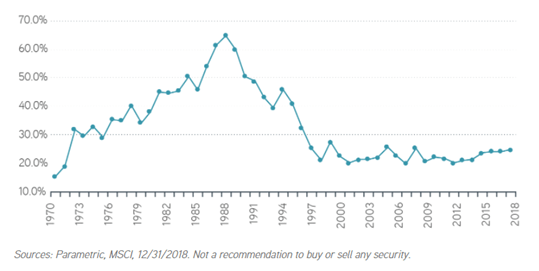
Although investing at such extreme prices seems foolhardy; passive global equity investors would have been increasingly exposed to Japan as the bubble inflated with their allocation hitting 45%. On an EAFE basis the concentration reached 65%:


Does this trait of growing exposure to astronomically priced assets mean a market cap based country allocation is a terrible idea?

No, it is perfectly rational. It just comes with costs and limitations. As with any investment strategy.   

In this binary world our default view is to stridently take one side and vehemently oppose the other. Committed passive investors will claim that an active country allocation is non-sensical given the underwhelming performance history. Active management advocates will argue that any approach that ingrains objectively bad decisions – like allocating half of our assets to staggeringly expensive markets – runs counter to all evidence about what drives long-term returns.

Financial markets are just too noisy and uncertain to take such forthright and singular views. Often two statements can entirely contradict each other whilst both being true.

Take the below examples:

A passive, market cap approach to global equity investing has and will prove to be an effective long-term option for many investors.

and

Investing near half of our equity assets in a market trading at 100x cycle adjusted earnings is an awful strategy.  


If we accept the evidence that buying very expensive assets is a recipe for poor future returns; how is it possible to claim that passive global equity investing can also be a sensible course of action?

There are several valid arguments a passive investor might make:

1) We do not believe there is another method that can consistently put the odds in our favour. It is not enough to say that a market cap, global equity allocation is deeply flawed; we need to have confidence in a robust alternative.

2) The long-run return of global equity markets incorporates incidents of bubbles and manias; they are a known and expected feature that must be withstood.

3) We have no way of telling where a bubble will occur, how far it will rise or when it will crash. Therefore, it is best simply to weather them.

4) It is easy to lament the cost of a bubble or the impact of buying expensive assets in hindsight; it is much more difficult to accept the years of painful underperformance which will come when we reduce our exposure early, yet the momentum continues. The behavioural challenges of an active approach are far too great to bear.

5) Country allocations based on market cap are a reasonable proxy for future earnings on average, despite being wildly inaccurate at times.

None of these arguments suggest that buying extremely expensive assets is prudent, rather they accept the drawbacks of a passive country allocation, whilst believing it to be the best (or least worst) option.

As guilty as active investors are of dismissing the evidence around the efficacy of index funds however, passive investors are equally culpable in rarely acknowledging the shortcomings they suffer. Even committed passive exponents should ask themselves whether there are any scenarios where index exposures become so extreme that they would be willing to go against everything they believe and take active positions away from the benchmark.

What would they do in a repeat of the Japan scenario?

Situations like the one we observed in late 80’s Japan will likely occur again; perhaps we are entering such a phase with the US.

It is easy to be complacent about the rise of US equities to close to 70% of the MSCI World Index. The strong performance that has led to it and the narratives used to rationalise it make extrapolation and justification easy. But we should not ignore that passive investors are becoming progressively more exposed to one of the most richly priced global equity markets.

So, is the US a Japan redux? No. The valuations are nowhere near as extreme (which is not really saying much) and the corporate fundamentals do justify a high US weighting. The FTSE RAFI Developed 1000 index, which weights companies based on factors such as dividends, cash flow and sales has a US equity allocation of c.59%. Not quite 70%, but even if we disregard stretched valuations, the US is still the world’s dominant equity market.

Not being Japan does not mean investors should blindly accept the situation. History would suggest that stretched valuations lead to disappointing returns. It is hard to argue that valuations in the US are not elevated (even relative to other regions).

I have heard passive advocates justify the increasing US weighting by making claims about US exceptionalism and the incredible profitability / market dominance of the tech and consumer names. Whilst this might be a credible case it is conflating an active investment view with the use of index funds.  The correct argument – as mentioned above – is that this type of situation is a known and expected feature of a market cap, global equity allocation; and they believe it to be the best method for capturing long-run global equity returns.  


There are many awful ways to invest that we should avoid at all costs, but there is also no right way -just a range of reasonable techniques all of which come with advantages and serious drawbacks.  Most investors align themselves with a particular religion (active or passive) and summarily dismiss the other. This is unhelpful and belies the realities of hugely uncertain financial markets with often conflicting evidence.

In simple terms, passive country allocators need to accept that they will buy increasing amounts of punitively expensive assets; whereas active investors (at least those with a valuation discipline) will endure multiple years (maybe decades) of severe underperformance even if they are right in the end.

No approach is perfect, we must pick our poison.


[i] The Age of Disorder – Deutsche Bank (db.com)

The Dog and the Frisbee – Why Investors Should Consider a Simple Approach to Complex Markets

At the 2012 Jackson Hole Economic Policy Symposium, Andrew Haldane, who went on to become Chief Economist at the Bank of England, gave a speech to the gathered central bankers entitled: ‘The Dog and the Frisbee’. It was about simplicity and complexity. The speech began:

“Catching a frisbee is difficult. Doing so successfully requires the catcher to weigh a complex array of physical and atmospheric factors, among them wind speed and frisbee rotation. Were a physicist to write down frisbee-catching as an optimal control problem, they would need to apply Newton’s Law of Gravity”. [i]

Dogs are good at catching frisbees, does that mean that they understand Newtonian Physics? No. A dog can make a successful grab for a frisbee by applying a simple rule of thumb: running at such a speed that the frisbee is maintained at an approximately constant angle.

The unusual but eloquent point being made by Haldane was that simple rules are often the best approach to solving or managing complex problems. Complex solutions are often too slow, ineffective, or designed to deal with yesterday’s challenges.

Financial markets are far more complicated than catching a frisbee, but we often seem resistant to adopting simple approaches.


Haldane’s speech drew heavily on the work of German psychologist Gerd Gigerenzer who is an advocate of using fast and frugal decisions rules, or what he calls simple heuristics, to make judgements and predictions in certain environments. There have been countless examples of studies testing Gigerenzer’s ideas. In one such study, researchers looked at the Wimbledon 2003 tennis tournament and found no difference in the quality of match predictions between laypeople simply choosing the name they recognised and the complex, computer generated rankings. [ii] This is known as the recognition heuristic.

A more pertinent example for investors regards portfolio optimisation; creating the mix of securities that can deliver the best or optimal returns for a given level of risk. A study showed that rather than utilising complex, computer-driven optimisation approaches incorporating returns, risk and correlations, the most effective rule was 1/n, which means to equally weight all available options.[iii]

This is the approach Harry Markowitz – the father of modern portfolio theory and winner of the 1990 Nobel Memorial Prize in Economic Sciences – is said to have adopted for his own investments.

Why would such a seemingly naïve approach work when dealing with such a complex problem?

Gigerenzer argues that simple heuristics are effective when the environment meets three key criteria: [iv]

 i) A high level of uncertainty.

ii) Many options.

iii) Short sample.

It is incredibly difficult to make optimal decisions in complicated, unpredictable environments where there is a broad assortment of choices and insufficient historical evidence. Optimizing for the past does not mean optimizing for the future.

Investing meets Gigerenzer’s three criteria. Yet rather than aiming for simplicity investors often layer complexity upon complexity. Not only is there the baffling variety of potential securities, funds and asset classes to assess; the markets in which we invest are adaptive and unpredictable.

Given this, why do investors often seem to prefer complexity over simplicity?   

There are four major drivers:

–  It can feel incongruous or even naïve to address a complex environment with a simple solution. To solve an intricate multi-faceted problem we must adopt an equally elaborate approach.  

– When we are presented with a complex situation with a huge range of variables and potential outcomes, the opportunity to over-engineer answers can prove irresistible. The torrent of noise makes us believe that there is always a better way.

– Complexity sells and sells for a higher price than simplicity. It is hard to differentiate ourselves, our product or our business by providing simple options.

– After the event, simplicity often won’t look like the best route to have taken as there will always be something more sophisticated that has delivered better results.


A simple approach is no panacea; an ill-judged decision rule or heuristic can lead to very bad outcomes. Simplicity does not equal efficacy. We should not, however, be in thrall to complexity. Investors should start with simplicity and make things no more complex than they need to be.


[i] https://www.bankofengland.co.uk/paper/2012/the-dog-and-the-frisbee

[ii] Serwe, S., & Frings, C. (2006). Who will win Wimbledon? The recognition heuristic in predicting sports events. Journal of Behavioral Decision Making19(4), 321-332.

[iii] DeMiguel, V., Garlappi, L., & Uppal, R. (2009). Optimal versus naive diversification: How inefficient is the 1/N portfolio strategy?. The review of Financial studies22(5), 1915-1953.

[iv] G.Gigerenzer, Rationality for Mortals: How People Cope with Uncertainty (Oxford University Press, 2008)

Mark Twain, Framing and Scarcity

In the second chapter of Mark Twain’s The Adventures of Tom Sawyer the protagonist is in a spot of bother. He has been involved in another scrap and as punishment is tasked by Aunt Polly to spend his precious Saturday whitewashing ‘thirty yards of board-fence nine feet high’. It seemed that a bleak day lay ahead for poor Tom, yet in a matter of hours boys from the town were queuing up to take a turn with the brush. Not only that, but they were paying Tom for the privilege.

How did he manage such a feat?

He applied some behavioural tricks to transform the situation, using the power of framing and scarcity.

Tom Sawyer has some lessons for investors.

As he was beginning his work on the fence, Tom was approached by Ben Rogers, a boy from the town.

Ben began to ridicule Tom’s predicament:

‘Say, I’m going in a-swimming, I am. Don’t you wish you could? But of course you’d druther work, wouldn’t you?’

Tom desperately wished he could stop painting and go swimming but he didn’t let on. Instead, he changed the frame:

‘What do you call work?’

‘Why, ain’t that work?’

‘Well, maybe it is, and maybe it ain’t. All I
know is that it suits Tom Sawyer.’

Tom re-frames the situation. Painting isn’t a chore; it is what he wants to be doing. He would rather be whitewashing than swimming.

As Tom lovingly returns to his meticulous task, Ben’s perspective is changed entirely. He stops mocking Tom, instead he asks for a turn.

Tom reframes the situation by evoking a key driver of our behaviour – the notion of scarcity.

Painting the fence is not arduous graft, it is a rare privilege that is not available to everyone.   

‘Does a boy get a chance to whitewash a fence every day?’

‘I reckon there ain’t one boy in a thousand, maybe two thousand, that can do it in the way it’s got to be done’.

Tom was able to spend the day relaxing and ponder how he had managed to get three coats of whitewash on the fencing, whilst almost bankrupting all the boys in the town.

Why do the actions of Tom Sawyer matter? Because framing and scarcity are critical to how we make decisions and are vital concepts for investors to understand.


We can consider framing to be the lens through which we interpret the world. The mental models that we apply to inform our view on a particular situation. The frames we apply can be intransigent and all-encompassing, such as a strident political view which influences how we understand almost everything. They can also be or more focused and potentially malleable – like Ben’s view on the joys of whitewashing a fence.

Some frames can be easily shifted, others cannot.

We spend a great deal of time trying to change the mind of people we disagree with by to them explaining how we see things – this is likely to be fruitless. We need to understand that they are viewing the evidence through an entirely different frame. Our starting point in the face of differing opinions should be to try and view the situation through the other person’s frame.

Many intractable investment debates are a faming problem. Take the inherent friction between a strong advocate of ESG-focused investing and a proponent of the idea that shareholder returns are paramount above all else. No amount of discussion and deliberation about the specific evidence is likely transform any side’s viewpoint, it is a framing problem. Understanding the model each side is applying is likely to be far more productive than exchanging different studies with contrary evidence.

Some of our most significant investment mistakes are also likely to be a problem of framing. It is not that we made a wrong call on a particular market or macro-economic event, it is that we were viewing the world through an entirely incorrect frame. An investor whose initial experience was in the 1970’s is likely to have an entirely different model for thinking about interest rates and equity markets, than someone who has only experienced the most recent decade.

The major challenge for investors is that markets are complex adaptive systems – how they function through time will evolve. Applying one overarching frame is unlikely to be a successful approach. We need to understand the frames that we use which are likely to prove robust through time (short-term market movements are unpredictable noise) and those which are subject to change (bond yields always fall if equities are weak).

It is important for investors to think more explicitly about framing – why we see the world or the situation as we do. There are three key benefits:

1) It allows us to better challenge our own views. Our beliefs about a subject are likely the result of the specific frame we are using. We need to worry less about the information we are observing and more about the lens through which we are looking upon it.

2) It enables us to understand the perspectives of others. It is easy to disregard the viewpoints of people we disagree with, without ever attempting to understand the frame they are using.

3) It can assist us in encouraging good investment behaviour. How can we influence people to become long-term investors? Think about the frames they are applying and try to shift them.


Tom Sawyer did not just change the framing of his task by highlighting how much he enjoyed it, he applied the scarcity principle. We desire things more and ascribe them a higher value if we believe they are scarce.

The perception of low or restricted supply increases the demand and price.

The concept of scarcity and how it influences our behaviour is critical to how we consider the value of different assets or investments. It is an idea that has seemingly become increasingly relevant in recent years.

In simple terms we can think of an asset or object as possessing value for three reasons:

1) It has some use or utility.

2) It provides us with a cash flow (often related to its utility).

3) It is scarce.

If something has no or little utility and does not generate a cash flow, then its value is likely to come from scarcity. It seems unlikely that something that is abundant and has no use will be of value.

To create value without utility, we need scarcity.

Of the three drivers of value, scarcity is the exception. This is because its perceived worth is not driven by the asset itself but entirely by the perceptions others hold about it. Whilst the value of all assets are impacted by the beliefs of others, most are underpinned by utility or cash flows.

Why can scarcity create value, or at least the perception of value? Social proof is perhaps the critical element – our view is informed by the behaviour of others. It must be valuable because everybody else thinks it is.

The information we take from the actions of others is compounded by the fear that we are being excluded – limitations in supply make us view the situation through the frame of loss. What is it we are missing out on?

The more boys from the town turned up to help paint Aunt Polly’s fence, the more other boys wanted to join the queue.

As much as scarcity value is about other people, it is also about us. Scarcity is deeply intertwined with signalling – the decisions we make to manage how we are perceived. Items that are rare or difficult to attain are attractive because they say something about us, about the group we belong to. Nobody buys an expensive, branded t-shirt because it has significantly more utility than a simple option, they do it because they want to signal something. Here there is a circular relationship between scarcity and price. The higher the price of something the more scarce or difficult it is to obtain, which makes it worth more as a signalling tool.

The other vital element of scarcity is the narrative. Not all items or assets that are scarce are deemed to be valuable, particularly if they are useless. So, the story matters. The story also becomes more powerful the more the perceived value increases. Price change begets story begets price change. And so, the cycle continues.

Assets with a value driven solely by scarcity can be dangerous for investors because there is no supporting worth or utility. We are beholden to the behaviour of others. Yet, we should not be too dismissive of a factor that can exert a huge influence on the behaviour of financial markets and asset prices.


Tom Sawyer elegantly uses the framing of scarcity to transform the perception of his situation and change the behaviour of others.

He had discovered a great law of human action, without knowing it – namely in order to make a boy covet a thing; it is only necessary to make the thing difficult to attain.

He changed the frame. What frame are you viewing the world through?


Twain, M. (19876). The Adventures of Tom Sawyer,


Betting Against Warren Buffett

Suspend your disbelief for a second. Imagine you have been gifted $1m, the only proviso is you must split the amount between an equally weighted 30-stock portfolio of US listed companies selected by Warren Buffett and a 30-stock portfolio of US listed companies selected by…me. You get to keep the amount staked on whichever portfolio produces the highest return.

Where would you put your money?

Of course, it is impossible to take any view on likely outcomes because we are missing a vital piece of information – the time horizon. When considering luck and skill in investing this is the most important thing. It changes everything.

Let’s say the time horizon was just a single day. The odds of my portfolio beating Buffett’s must be 50%. One day’s stock market movement is nothing but random noise. $500,000 each seems a prudent approach.

What if the length of the bet is increased to one year? The chances of my portfolio might be a little less than 50% but only modestly. Nobody can accurately and consistently predict in advance what will happen in equity markets over the next year. Fundamental company attributes are unlikely to matter that much compared to events, narratives and flows. The result would not be far from a coin toss.

How about three years? This is an important timespan because it is often the period over which fund investors hire and fire active managers. We should expect some advantage to arise from Buffett’s acumen and experience here, but the results would still be extremely variable and hugely influenced by sentiment, rather than the aspects of a business Buffett cares about.

We could use base rates to help us size the bet. Between 1988 and 2019 Berkshire Hathaway outperformed the market on c.60% of rolling 3-year periods.[i] A $600,000 stake towards Buffett would seem sensible.


The tangential point here is that on the time horizon adopted by most fund selectors, Warren Buffett would have been sacked on multiple occasions over his staggeringly successful investing career. Past performance can be a terrible decision-making tool.


Now, back to the bet. 

Finally, let’s try a 10-year time horizon. We are getting into the realms of long-term investing. Company fundamentals should matter more. Skill should start to exert a material influence. But how much?

Let’s go back to base rates. Over the same period as previously mentioned Berkshire Hathaway outperformed the market on close to 90% of rolling 10-year spells. We might now have more confidence placing $800,000 or $900,000 on Buffett’s side of the table.

Time horizons matter.

When thinking about the bet; don’t worry too much about my limited capabilities in stock picking, just assume that I design my 30-stock portfolio to look as much like the market as possible. Also, it doesn’t have to be Warren Buffett – just a highly skilled stock picking investor. The message will be the same.

So, what is the message?

1) Conversations about luck and skill in investing are irrelevant unless we specify a time horizon. For most styles of investing, the longer the time horizon the more skill will influence outcomes. Whatever the time horizon, however, the results will never be devoid of chance.

2) Investing is a bizarre activity. Over reasonably lengthy time horizons (one year, three years and more) people without any discernible skill will produce better results than the most skilful individuals in the field. There are very few activities that are structured in this way.

We hugely understate the role of luck in investment outcomes. Humility is a pre-requisite for good investing. Sensible decisions will appear mistaken – a lot.

3) Active fund investors have their time horizons all wrong. Attempting to identify skill and then worrying about one and three-year performance is entirely futile. We are doing little more than playing roulette (particularly if we acknowledge that we are unlikely to identify the greatest investor of their generation in advance). A focus on short run horizons will doom us to making persistently bad decisions based on the unpredictable movements of markets.

If there is any chance of success investing in active funds, we must extend our time horizon. If that is not possible, we should not be using them.


[i] Daily: Firing Warren Buffett | UBS Global

Long-Term Investors Must Make a Ulysses Pact

In Homer’s Odyssey, Ulysses and his crew must navigate their ship past the sirens. The sirens produce a beguiling and irresistible song, which if heard would lead the men to their deaths. To be the first person to hear their song and live, Ulysses applies some behavioural science. He creates a commitment device in the present to protect his future self. He instructs his crew to fill their ears with wax to avoid temptation and has himself tied to the mast to avoid action. If investors want to enjoy the benefits of long-term investing, we must adopt a similar approach.

Stephen Pinker discusses this type of behaviour management in his new book Rationality. He notes that Ulysses surrendered his ability to act and the sailors their option to know. This is puzzling because wilfully relinquishing information and agency seems deeply irrational. Yet if we are aware of the challenges and impulses that await us, it can be the most rational approach to achieving our goals.

As investors we find ourselves in a similar situation to Ulysses. Most of us have long-term objectives best facilitated by doing less, yet the constant noise and narratives of markets are there to lure us into frequent injudicious decisions.

Being a long-term, low action investor is the easiest approach to adopt in theory, but the hardest in practice. How do we make a commitment like Ulysses to protect us from our future investing selves?

Plugging our ears like the sailors means ignoring the chaotic vacillations of markets and the unpredictable path of the economy. Rarely checking our valuations, cutting off our subscriptions to financial news. Avoiding anything that will entice us away from our plan.  

Tying ourselves to the mast means making action far more difficult than inaction. Cancelling the brokerage account, losing the password for our portfolios, or adding elements of friction to slow an investment decision-making process.

Of course, we don’t do any of these things. It feels absurd to disregard ‘critical’ information and constrain ourselves from making ‘vital’ investment judgements. We also find it difficult to believe that we will make poor choices in the future – surely, we will behave in a perfectly rational manner no matter the environment?

As with so many things in investment, taking the right behavioural steps to achieve good outcomes can seem irrational and imprudent.  Saying ‘I don’t know what markets did yesterday, and I don’t really care’, probably increases the odds that our long-run outcomes will be good, it is just that everybody will think we are incompetent.

Professional investors naturally dislike this type of Ulysses pact.  We are paid to engage with markets and act, irrespective of whether that activity is beneficial.  We must listen to the siren song and probably erroneously believe we can avoid the rocks whilst enjoying the melody.  

Commitment devices do not have to be entirely restrictive, however. They can be designed so that our future self is more likely to exploit opportunities that arise. We might commit to acting only when certain extreme valuation levels are reached. This approach is obviously imperfect compared to an avoidance pact because we will still have to implement the decision when the time arrives (and will no doubt create excuses as to why it is no longer a good idea). Setting a high threshold for action, however, at least protects from the worst ravages of noise and overtrading.  

A critical part of managing our behaviour is understanding the challenges we will face and planning in advance how we will mitigate them. Good investment is primarily about making sensible decisions at the start and avoiding bad decisions on the journey. The problem is that the compulsion to veer off course is likely to be overwhelming.  

Most of us want to be long-term investors, but unless we make the right behavioural commitments at the outset the siren song of financial markets will make that an impossible aspiration.

Should Investors Care about an Asset Manager’s Culture and Brand?

Asset managers spend a great deal of time cultivating their brand and extolling the virtues of their culture. Although as an investor it is easy (and enjoyable) to be dismissive of these activities, they do matter. Investing in a firm with a toxic work environment and invectives wildly misaligned with our own is unlikely to lead to positive outcomes. If a firm or team’s culture is at odds with its investment philosophy, the culture will win out. Culture is critical but gauging it from the outside is incredibly difficult to do. The only way to better understand it is to ignore the words and instead focus on behaviours.

We should not think about culture without also considering the issue of brand. The two are deeply intertwined and can be considered different sides of the same coin. One external to a company and one internal. A brand is the perceptions held about the behaviours of a company by outsiders. A culture is the expected behaviour of insiders within a firm – what is permitted, enacted, and rewarded. Asset managers are unlikely to sustainably and successfully reset a brand without also addressing the underlying culture.

The cynicism that meets much of the talk around brand and culture within the asset management industry is entirely fair. It is so often vacuous nonsense – a superficial effort to manage perceptions. Establishing or transforming a brand is not about slogans, fonts or colour palettes, it is about changing the beliefs held about a company’s activities. If a company changes its name but its behaviour is consistent with the past, then existing opinions will simply transition to the new name.

If there is an effort to modify the brand and culture of a business, it is critical to ask – “what actions and behaviours are changing and why?” Not – “what is it you are calling yourself now?”

Given the industry’s focus on performance, it is possible that strong brands can exist when the team culture underlying it is poor. Investment returns can be impressive in a bullying, exclusive environment where client outcomes are subordinate to that of the business, but they are unlikely to be sustainable – the culture will lead to a reckoning at some juncture. Even if strong returns do persist against such a backdrop, we should ask ourselves whether it is the type of business with which we are happy to entrust our money.

Situations can also exist where a company has made material strides in improving its culture, but its brand remains tarnished because of past deeds. In such instances, shifting the optics (changing the name or logo) might help to allow the brand to reflect the evolving culture but will be insufficient. There needs to be consistent and meaningful evidence of what is changing. Skoda’s brand image would not have evolved had they not also improved the quality of their cars.

Assessing the culture at an asset management business is not easy. The starting point is to dismiss everything that you are told and anything that appears on a PowerPoint deck, and instead focus on tangible actions. It is easy to extoll the virtues of an inclusive environment in which the many different forms of diversity are paramount, but what is actually being done about it? Have concrete policies been put in place to facilitate this?

If the purported culture is based on putting the long-term interests of the clients first, how is that achieved? What remuneration structures are in-place to incentivise behaviours that are aligned with this mindset? How is the firm overcoming the pressure of meeting short-term financial objectives?

There is often a yawning gulf between what a firm says about its culture and what it actually does.

When assessing the culture of an asset management business, we should start by asking two questions: i) What are the cultural features (expected behaviours) we would expect to see at a high quality investment organisation? ii) What are the cultural elements that would support the application of the specific investment approach we are considering?

As an outsider there are a variety of ways to build a better understanding of culture within a firm or team. Those with privileged access can attend internal meetings and obtain details on incentive structures and historic staff turnover. It doesn’t have to be that difficult, however. Sites such as Glassdoor can be insightful, as can conversations with previous employees. We can also observe how the company engages with different stakeholders. The messages given by management to shareholders may well differ with those offered to potential investors in their funds – shareholders will hear about cost cutting and improving short-term flows, investors will hear of continued investment in the business and the paramount importance of adopting a long-term approach.

What we are seeking to understand is whether a firm’s behaviours and expected behaviours (its real culture) are consistent with what it says and what it is trying to achieve. There is no magic bullet to judging this, but we can easily build a framework or checklist, and reach our own conclusions.

Asset management firms should care about culture not because it sells or helps improve the brand, but because it leads to better outcomes for all stakeholders. Investors should care because our outcomes will be driven by the behaviour of the individuals in the firm with which we are investing.

It is so easy to poor scorn on culture and brand as amorphous and frivolous concepts, particularly when most asset managers play the game of saying the right things to best support and furnish their desired image. Culture is frequently discussed without anyone taking the time to explain it; but this doesn’t mean we should dismiss it. At its heart culture is about behaviour, and there should be few things as important to investors as that.

Investors Should Prefer Camels to Horses

There is a common decision-making adage that states: ‘a camel is a horse designed by a committee.’  Although there is some doubt over its origin it is thought to have been first uttered by Sir Alec Issigonis, designer of the iconic Mini car. The ungainly camel represents the flaws of committee-led design, which is often defined by indecision, competing interests and compromise. The sleek horse is the result of individuals or small teams operating with focus and a distinct purpose. Although it is a wonderfully salient maxim, it is deeply flawed. Camels are a design / adaption marvel and in areas such as investing they provide invaluable lessons about how best to deal with uncertainty.

The idea that a camel is a poorly conceived horse does a huge disservice to a fantastically versatile creature. Adapted for desert living, camels must deal with dramatic temperature extremes from +50°c to -40°c. This means that they cannot use fat as insulation (as many animals living in cold climates do), but instead store fat in humps and have insulating fur. The energy stored in their humps mean they can go for sustained periods without food; whilst their technique for processing water allows them to survive for days in the severest droughts.

Although not as rapid as the fastest horse they are no slouches with certain species able to run up to 40mph. They are also ideally suited to long distance toil. Bactrian camels can carry 200kg (440lbs) for 50km (31 miles) per day. Camels have a range of other adaptions that allow them to survive and function in hostile environments such as wide padded feet, an extra-long intestine (to aid water absorption) and a fluctuating body temperature. They are creatures built for variability and uncertainty.

We are drawn to horses because of their appearance and speed, but their design is only superior to a camel if we are certain about the distance, environment and terrain. The less we know about our future path and the conditions we will encounter, the more valuable the resilience of the camel becomes.

The preference for the alluring features of a horse over the unwieldy camel is also suffered by investors. Most of us have long-term objectives requiring a portfolio that can withstand extreme variability in the environment and cope with material uncertainty. We are, however, so often tempted by options that have proved themselves ideally designed for the recent past and assume those conditions will persist. This leaves us sharply exposed to the realities of a complex and dynamic system.

Even when we acknowledge that the investment landscape will be changeable our tendency is to believe that we can foresee this and adapt our positioning accordingly. When we attempt to time markets or invest in funds that do, we are declaring that we can forecast the undulating path ahead and identify the investment ideally designed to navigate it. Although the promise of holding the perfectly tailored investment vehicle at the appropriate moment is an appealing aspiration, it is also an exercise in profound and costly overconfidence.

A prudently diversified portfolio is akin to a camel; it is not the most attractive choice and at any given time there will always be a superior option to deal with the current circumstances. It feels like we are always making concessions and carrying unnecessary burdens. Those fat storing humps on a camel seem superfluous when food is abundant, but much like the drag of holding anything but the most in-vogue asset class or fund, they are essential tools for an uncertain future.

If we are asked to undertake a long journey along an unpredictable path we should take lessons from the design of a camel, not a horse.

What is Your Investment Edge?

The idea of an investment edge is a simple one. It means that there are some features of an investment behaviour that improves the odds of better outcomes. Although the concept is straightforward, locating edges and creating an environment that fosters them is incredibly challenging. This is primarily due to the difficulty in specifying and evidencing them. Many established active fund managers – who are selling edges – struggle to articulate their own supposed advantages. Edges are, however, not the sole domain of active managers; whenever anyone is making an active investment decision they should understand the edge they have in doing so, otherwise they should not be doing it. 

Types of Investment Edge

The starting point for overcoming the problems of identifying an investment edge is defining the different types that might exist. I consider there to be three broad groups, which each include a range of more granular sub-groupings, these are: Analysis, Behaviour and Implementation:

Analysis – What information is used and how it is used

Informational
– Investors access more / unique information (insider trading is an edge, albeit an illegal one), or use different / new types of information.

TechnicalInvestors have specific technical skills that provide them with an advantage in assessing securities and markets. For example, a complex MBS strategy.

CriticalInvestors use information in a distinct fashion, which provide differentiated insights.

Behaviour – How an investor makes decisions

Decision Making I – Investors structure a decision-making process that mitigates the impact of our behavioural limitations.

Decision Making II – Investors structure a decision-making process that exploits the impact of our behavioural limitations. Most factor-based strategies are founded upon such an edge.

Emotional – Investors manage and control their emotions, so that their decisions are not overwhelmed by how they feel.

Environment Investors work in an environment that supports the objectives of their investment approach. The obvious example here being a high conviction active manager who is incentivised based on the long-term results of their strategy and supported through prolonged periods of underperformance.

Temporal – Investors make long-term investment decisions absent pressures of short-term performance or noise. This is the incredibly powerful edge that private investors hold over professionals.

Implementation – How an investor implements ideas

Trading Investors can skilfully trade in and out of positions.

Portfolio Shape
Investors have an advantage in how they construct their portfolio or how they weight conviction in certain ideas.

Not all edges are created equal. Given the abundance of information the potential for a credible analytical edge now seems far lower than has historically been the case. Edges are also not mutually exclusive, often they are dependent upon one another. For example, a temporal edge can only be credible within a supportive environment.

Although there are simple investment edges most (particularly those that are not easily commoditised) are a complex web of complementary or (sometimes) conflicting elements.

Key Questions About Investment Edge

The categories of investment edge are by no means exhaustive, but I would expect most to fall within these groupings. Critically, defining edges in these terms is only a starting point for more detailed analysis. There are three critical questions to ask about any purported investment edge:

1) What type of edge is it? It is not sufficient to state that an investor has an edge that sits within a certain category, we need to be clear about precisely what it is, otherwise it becomes close to impossible to evidence. Edges can be very general – buying companies that are cheaper than the market. They can also be specific – complex country models to assess the credit quality of an emerging market.    

2) Why does the edge improve the chances of better returns? It is important not to accept an investment edge at face value. We need to create a hypothesis as to why it might improve our results. We can never be certain, but unless we can make a plausible claim as to why an edge should lead to excess returns, then it probably isn’t an edge.

3) Can we evidence the edge?  Now comes the tricky part. If we have identified an edge and have created an argument as to why it may lead to better outcomes, we need some means of evidencing it. Obtaining confidence in edge (or skill) is all about drawing a consistent link between process and outcome. The typical and flawed approach to this is to discover an investor who has outperformed and then assume that their edge must therefore be effective. Markets are far too random and noisy to make such inferences. There are many investors with no credible edge that will appear as if they do when we focus on performance in isolation.  Instead, we need to ask what type of behaviours are likely to result from the edge and identify whether that is apparent in the decision making of the investor.

There are inevitably challenges with this approach. Sample sizes are often small and the evidence base lacking. Also, the more nuanced and intricate the edge, the more difficult it is to draw a causal link between it and outcomes. This means we must adjust our confidence in the existence of any supposed edge and should correct our investment conviction accordingly. Any view on an edge is a probabilistic judgement informed by the evidence available.

If we don’t attempt to evidence an edge then we cannot develop a reasonable level of confidence that it exists or observe when it has been compromised or competed away.

How to Identify an Investment Edge  

Generating convincing evidence about the existence of an investment edge is undoubtedly a challenge, but there is an even more fundamental problem. It is often difficult to decipher what the actual edge is. Even investors who should have one (because they charge for it) struggle to convey what precisely they believe their advantage to be. Fortunately, for most traditional, qualitative investment approaches there is a simple resolution. We just need to ask the fund manager one question:

“Could you effectively systematise your investment approach?”

Inevitably most active fund managers would baulk at the notion that their nuanced investment process can be transformed into an algorithm; for a start it does not augur well for their career prospects if the answer is yes. More importantly, if the answer is no the reasons they give as to why it cannot be made systematic should provide a clear view of their purported investment edge. By definition, they must believe that there are distinct elements of their investment process that cannot be easily or consistently replicated. Whatever is supposedly lost through systematisation, is likely to be some form of supposed edge.

Identifying a possible edge does not mean that an investor possesses a genuine one – most of the time it will not be – but it gives us a clearer sight of what that edge might be. We can then test it.

Most active investment strategies will feature two levels of potential edge – a base level ‘risk premia’ that can be easily systematised and then a more nuanced secondary level which reflects the specific features of their approach.  For example, the manager of a value equity strategy will have a base level edge of buying cheaper companies than the market (easy to replicate, but still with historic efficacy) and the second level that is the distinct elements of their process that allows them to produce better outcomes than the cheap, simple version of the base level edge. The second level is what investors are paying for, but it is much harder to evidence credibly, and we should have less belief in it.


This post might read as if it is solely about how we perceive the investment edges of other investors, but it is not. We must always view ourselves through the same lens that we judge other investors.

When we make an investment decision, do we know what our edge is?

Nobody Really Thinks About Behaviour 

It is easy to think of investing as a technical endeavour, where we can develop specialist knowledge and insights to improve our results. We expend a huge amount of time and energy on enhancing models or refining processes to gain some edge or advantage. It is difficult to argue against this drive for progress.  Yet, in investment, what feels right can often lead to worse outcomes. The desire for more information, more precision and more complexity almost inevitably impairs the quality of our decision making. 

Despite its rise to prominence in recent years, investors are still not thinking about behaviour nearly enough.

The arms race to improve technical sophistication is understandable, but a major failure in prioritisation. Do we really believe that our analysis is going to be better than the next person? Is it worth allocating inordinate resource to the slim chance that it might be? Are our research and analytics going to be superior to the house with 100x the capabilities that I / we have?

There is nothing wrong with enhancing our technical proficiency, but it should be subordinate to considering our behaviour. The potential to improve our results by understanding and managing our behaviour outstrips any other changes we could make that might enhance our investment fortunes.

The first question any investor should ask is – how can I create an environment that minimises the behavioural challenges I will face?

So, why don’t we do it? In part, it is because we still don’t believe it. We can pay lip service to behaviour, but at heart we still see ourselves as rational decision makers.

Most importantly, making behaviour the critical part of an investment approach doesn’t feel or look right. Creating strong behavioural frameworks is often about doing less. Less activity, less information and fewer decision points. Good luck trying to pitch that.

To be successful long-term investors, particularly if we have short-term accountability, is staggeringly difficult. The very minimum we should be doing is acknowledging that the potential to make poor short-term decisions based on noise, emotion and incentives is exceedingly high.

Our default expectation should be that over the long-run we will make a lot of bad investment decisions driven by our behavioural limitations.

We should be trying to fix that first, rather than worrying about extracting some uncertain analytical edge.

The question that is never asked

The problem with treating behaviour like a distracting but ultimately meaningless sideshow is not only evident in the lack of priority attached to it, but how rarely it seems to be considered across the industry. All the way from asset managers to technology providers and regulators.

The obvious example is about the access all investors now have to their portfolios / investment accounts. An optically wonderful development but what are the behavioural consequences? (They seem obvious to me).

Whenever anyone is making a change to an investment process the first question that should be asked is:

“How will this impact behaviour?”

I am not sure it is ever asked.

Every change we make to our approach to investment will alter our behaviour. Even slight, seemingly inconsequential adjustments can have a profound influence on our judgements.

So often alterations are made which have good intentions but spell behavioural disaster. It is difficult to think of many developments in the investment industry in recent years that are not likely to make us more short-term and trade more frequently.

But if behaviour is so important, why don’t we care about it enough?

1) Many things that are likely to aid our behaviour appear regressive and unsophisticated (less interaction with markets / fewer decisions). Constraining choice, reducing information and adding friction rarely seems like a winning ticket.

2) As we struggle to see behavioural weakness in ourselves, we find it difficult to understand how it will likely impact other investors.

3) Many behavioural issues seem so minor that they are easy to disregard. We should never underestimate how small changes will have dramatic consequences for choices and outcomes. 

4) The requirements to be a good behavioural investor run counter to the structure of the industry and its incentives. The management of career and business risk are far more powerful than many realise. Short-term incentives always trump aspirations of good long-term behaviour.

5) The benefits of good behaviour are not always easy to see. There is no obvious counter-factual and they accrue over the long-term. We much prefer quick wins or approaches that feel like quick wins (but create long-term losses).

6) Good behaviour that gets the odds on our side can feel very painful in the short-term and is easy to abandon. It is not comfortable spending time doing less, when everyone else is doing more.

Every development to an investment process, platform or piece of regulation should be viewed through a behavioural lens. Ideally, each change should be designed to improve investor behaviour, as nothing will provide a greater net benefit. When changes are implemented that have the potential for negative behavioural consequences then specific steps should be taken to ameliorate these. This is the least we can do.

There is plenty of talk about behaviour, but unfortunately not much action.

What is More Difficult, Asset Allocation or Security Selection?

I was speaking with a friend recently and, as they also worked in the industry, our conversation inevitably turned to investment. We were discussing the difficulty of different aspects of the job, in particular the contrast between asset allocation and security selection. They were of the view that asset allocation was inherently more challenging, whilst I held the opposite position. As I reflected upon this discussion, I realised how important this issue was. If investors are undertaking an activity to improve outcomes it is critical to understand how difficult the task is and why. If we can answer this, we can judge whether it is worthwhile and what is required to carry it out successfully.

So, what is more difficult, asset allocation or security selection?

Before considering the specifics of the question, it is important to define some terms. If we are asking what aspects of investment are more difficult, we need to understand what we mean by it. We can do this by framing it as a simple problem:   

How easy is it to adopt and maintain a process that can improve the odds of better outcomes?

The issue of difficulty is really about skill – the capacity to consistently link process and outcomes in an intentional and positive fashion.  

And that brings us to the first question we should consider when considering the difficulty inherent of a given task:

Is it an activity where skill can influence the results?

Before even beginning to worry about the relative difficulty of anything, it is critical to understand whether we can consistently and positively impact results at all. Some activities are just too hard, and the results of our endeavours will be dominated by randomness. We can apply two tests to identify such situations:

Reasonableness test: Is it reasonable to believe that skill can influence an activity and offer some advantage? This is a simple sense check to avoid the pitfall of seeing patterns in random outcomes. If we get enough people flipping coins some will get five heads in a row, that does not mean it is reasonable to believe it is a task where skill can exert an influence.

In a field as complex as financial markets it is easy to get immediately lost in the weeds. It can save a great deal of time to start with first principles: define what the essence of the task is and the core assumptions that must hold to believe that skill can be a factor.

Evidence test: Is there evidence that the potential to influence outcomes with skill exists?  If we believe that an activity passes a reasonableness test, we need to validate this by looking at the data. Do historical outcomes support the idea?

We will have an example of an investment activity that may fail both of these tests later.

Once we have made a judgement on whether the results of an activity are likely to beholden to randomness, we can move to the next question:

What is the nature of the skill?

We can often fall into the trap of believing that investment difficulty is just an issue of technical complexity. It is simple to assume that the more technically challenging a skill is, the more reward we might enjoy from performing it well. This is a misnomer. Technical factors are one aspect, but equally important are the behavioural facets.

Technical skill is where there is inherent complexity in the task and expert knowledge is a necessary but not sufficient condition. Behavioural skill is where the task itself might be simple, but our ability to make the rational decisions required to improve outcomes is compromised. Both are types of processes that can lead to better outcomes, but the requirements to execute them successfully are entirely distinct.  

If we know what type of skill is required, we can attempt to judge how difficult it is to perform. Which brings us to the final question: 

How difficult is it to undertake the skill to improve results?

It is not sufficient to know whether skill can exert an influence on performance, we need to know how hard it is to successfully perform it.  Mowing the lawn and flying a 747 are both tasks where skill influences outcomes, but one is far more challenging to master than the other.

Difficulty matters for investors. Just because the application of skill might improve our results, it doesn’t mean it is a good idea to try. Not only because something might be so challenging that it is a waste of our time to even attempt it, but because our attempts might lead to worse outcomes than if we had not even tried.

The difficulty of any investment activity is also context dependent. For professional investors, the working environment is critical. If technical expertise is required, then the abilities of colleagues and quality of systems may greatly influence the feasibility in exercising a skill. If the skill is behavioural then steps must be taken to neutralise problematic biases. It is impossible to capture a behavioural premium from adopting a long-run approach (for example), if everyone is obsessing over quarterly results. Simple skills can quickly become impossible to perform.

Having created a framework for assessing difficulty and feasibility, we can consider the question posed in the title of this post. To muddy the waters slightly, I will address strategic asset allocation (long-term) and tactical asset allocation (short-term) separately, as they are markedly different endeavours.

Tactical Asset Allocation

Tactical asset allocation – adjusting portfolio exposures over short time horizons based on market conditions to improve returns or reduce risk – is undoubtedly the most difficult activity of those that we will discuss. It falls at the first hurdle. It doesn’t even pass a reasonableness test.

Is it reasonable to expect any person or team to confidently and consistently predict the near-term movements of a system as staggeringly complex and adaptive as financial markets? It is hard to contend that it is.  

Not only is it an unreasonable expectation. I am yet to see any compelling evidence that investors can add value by calling market directionality or asset class performance in the near term on a reliable basis.

If tactical asset allocation is so difficult and there is so little evidence of it working, why is it commonplace? It is likely a behavioural phenomenon. It is the very fact that financial markets are so chaotic and unpredictable that makes the idea of tactical asset allocation so alluring; because markets are turbulent and changeable there is an overwhelming urge to act. Something is happening – do something about it!

In an absurd fashion, it is often easy to be viewed as a negligent investor by do nothing even when it is overwhelmingly the most sensible course of action.

Tactical asset allocation is really about creating narratives, stories to talk to investors and clients about. The main advantage that stems from tactical asset allocation is the comfort clients may receive from seeing activity in their portfolio through difficult market conditions. This might help them stay the course. Despite this potential benefit, my sense is that money would be better spent educating investors on how boring and long-term investment should be, rather than using the indirect and uncertain behavioural benefit of tactical asset allocation.

In a ‘traditional’ multi-asset portfolio, tactical asset allocation is usually applied relative to a neutral allocation within some form of risk tolerance. For example, a portfolio can move underweight or overweight equities based on an assessment of market conditions. Attempting to adjust such exposures seems a futile task. Provided the time horizons / objectives of the portfolio are sufficiently long, the rational, evidence-based approach would simply be to permanently overweight equities within the portfolio’s risk tolerance and capture the long-run premium. This would get the probabilities of good outcomes on our side far more than attempting to time markets.

There are two problems with such a simple approach: 1) We cannot charge for it in the way we might for tactical asset allocation. 2) We will need to endure the difficult spells of equity performance to capture the probable return advantage. Neither seems like a compelling reason to persist with tactical asset allocation.

If short-term asset class timing is so difficult, what about if we adopt a longer-term approach?

Strategic Asset Allocation

Compared to tactical asset allocation, adding value through strategic asset allocation – the long-term (ideally 10 years+) mix of assets in a portfolio – is easy. If you don’t believe me, answer this question:

Maintaining prudent risk tolerances (say +5/-5% allocation changes or 1% tracking error budget) how confident would you be in outperforming a 60/40 portfolio over the next ten years by making strategic adjustments to the allocation?

I am not confident about many aspects of investments but my answer to this question would be somewhere around 80%. Why so high? Because I would simply overweight equities and underweight bonds. As the time horizon extends, I become more confident in receiving an additional return for the additional volatility. Risk-adjusted returns might be a little worse, but that is acceptable if you remain within the mandated risk tolerances and of course: ‘you can’t eat risk-adjusted returns’.

There are inevitably challenging scenarios where long-run equity returns from here are inferior to bonds, but that is captured in the 20%. If markets take one of those paths my modest overweight to equities is probably going to be the least of my worries.

Even if we take a more intricate approach, there is still evidence to suggest that over the long-run the returns from cheaper assets will outstrip more expensive assets. Over ten years I think that emerging market equities outperform US equities, but my confidence would be nowhere near 80%, probably closer to 65%. It is still, however, an evidence-based edge. It is also one that passes a reasonableness test – is it reasonable to expect cheaper major asset classes to outperform more expensive ones on average over the long-run? I think so. There is solid evidence supporting this type of strategic asset allocation behaviour and it is not technically difficulty, but there is a major problem – behaviour.

Although most investors time horizons are more than ten years, really none of them are. We care far too much about short-run outcomes, so our ability to capture improved returns from simple strategic asset allocation adjustments is incredibly limited. Whilst we can have a high confidence in a structural overweight to equities, can we maintain it through the inevitable bear markets – can we keep our job? Imagine attempting to hold an overweight to emerging market equities and an underweight to US equities position through years of thumping US outperformance. Although the odds may be on our side, nobody will believe they are.

It is not technically difficult to make prudent, long-run asset allocation decisions that get the probabilities in our favour, but few of us operate in an environment where we are able to exploit that advantage.

How do the behavioural challenges of top-down, strategic asset allocation compare to the bottom-up complexities of security selection?

Security Selection

We can consider security selection to encompass picking a collection of individual stocks or funds to improve upon the returns of a default, market cap index. As with SAA and TAA, we can split the activity into two elements: identifying companies that will improve on the returns of the market (stock picking) or structuring a combination of stocks to have attributes or biases that are distinct from a market cap approach (factor tilts). These are not mutually exclusive, but for the purposes of assessing difficulty it is helpful to treat them separately.

Stock picking is incredibly difficult – the evidence clearly attests to this – only the minority achieve exceptional long-term results. Unlike tactical asset allocation, however, it does not fail the reasonableness test. Is it reasonable to believe that it is possible to pick a collection of companies with better attributes than a selection based purely on their size?  Yes, it probably is. It is just very hard. Technically and behaviourally. Even if we have a technical edge that can add value, there will be arduous periods when it will appear that we don’t.

By contrast, factor tilts are not technically difficult to achieve. They are simple and commoditised. It can be accomplished by deviating from a market cap weighting methodology with virtually any other approach. There is also ample evidence that – over a long enough horizon – established factors provide some form of return advantage. It is also reasonable to assume that buying cheaper, higher quality, smaller sized etc… companies, on average, leads to better results.

The challenge of factor tilts in security selection is not technical, it is behavioural. Even factor tilts with vast amounts of empirical evidence as to their efficacy will underperform for prolonged and painful periods. This is a requirement rather than a bug, if there wasn’t some discomfort in holding a factor-tilted approach, there likely would not be a return advantage.

What’s the answer?

The answer as to what is more difficult: asset allocation or security selection is – it depends. We need to understand the specific details of the skill we are attempting to perform before making such a judgement. Strategic asset allocation may be a more worthwhile endeavour than tactical asset allocation but comes with its own profound challenges. Whereas factor-based stock investing is theoretically easy, but practically tough. 

The question is also inherently subjective. Reasonable people may disagree and the difficulty of any investment activity will be highly dependent on our environment. All investors, however, should be explicitly considering the likelihood that they can deliver positive results from the task they are undertaking.

We must remember that most activities that offer the potential to deliver improved returns will either be complicated (technically) or painful (behaviourally), sometimes they will be both. Whatever the cause of the difficulty we need to understand it if we are to have any hope of achieving better outcomes.